
Phoenix Rising
The Woman Who Will Decide 2025 and Beyond


Editor’s Note:
Since our July deep-dive, “Weighting for November,” we’ve been scraping mountains of data to pinpoint exactly who the persuadable voter is — in New Jersey this year, and across the country heading into 2026. This week, we’re pulling back the curtain and sharing what we’ve found. Meet The Phoenix through the eyes of a 12-year-old — our 3-minute video above shows the face of America’s persuadable voter.
What Happens In Jersey Doesn’t Stay In Jersey.
If you want to understand where American politics is headed in 2026, watch New Jersey in 2025.
It’s a deep-blue down ballot state with a toss-up governor’s race. It’s a test of whether Democrats can hold persuadable suburban women while keeping progressives engaged. It’s a test of whether Republicans can weaponize a new gender divide that’s giving them historic margins among young men. And it’s a test of whether authenticity — not ideology — can move the sliver of voters who will decide this race and the next ones.
Zoose numbers are clear: 85–87% of voters are locked in. The remaining 13% are overwhelmingly women 21–44 in suburban swing zones. They’re not doomscrolling. They’re juggling life. They’ll vote if a candidate gives them a believable fix to affordability, safety, and quality-of-life concerns — without performative politics.
And the progressive movement? It’s split. Emotional progressives will stay home if they think the fight is staged or the candidate is uninspiring. Pragmatic progressives will vote for anything but a Republican, even if it means holding their nose. That’s the quiet turnout crisis shaping every race in this cycle.
From Soccer Mom to The Phoenix
Why “The Phoenix”?
She’s not rising from ashes once in a lifetime — she’s doing it every single day. The 21–44-year-old persuadable woman rebuilds, resets, and pushes forward no matter what falls apart. Childcare falls through? She finds another plan. Rent spikes? She makes the math work. A client cancels, a kid gets sick, a bill hits early — she adapts on the fly. She’s constantly burning down yesterday’s chaos and building something new in its place. And in politics, she expects the same resilience: leaders who can solve problems, pivot, and keep moving without excuses.
In the 1990s and early 2000s, the shorthand for the swing female voter was the “Soccer Mom” — mid-to-late 40s, minivan, married, living in a stable two-income household, shuttling kids from one practice to the next. She had time to watch morning talk shows, skim the community newsletter, and weigh her vote around school budgets and neighborhood safety.
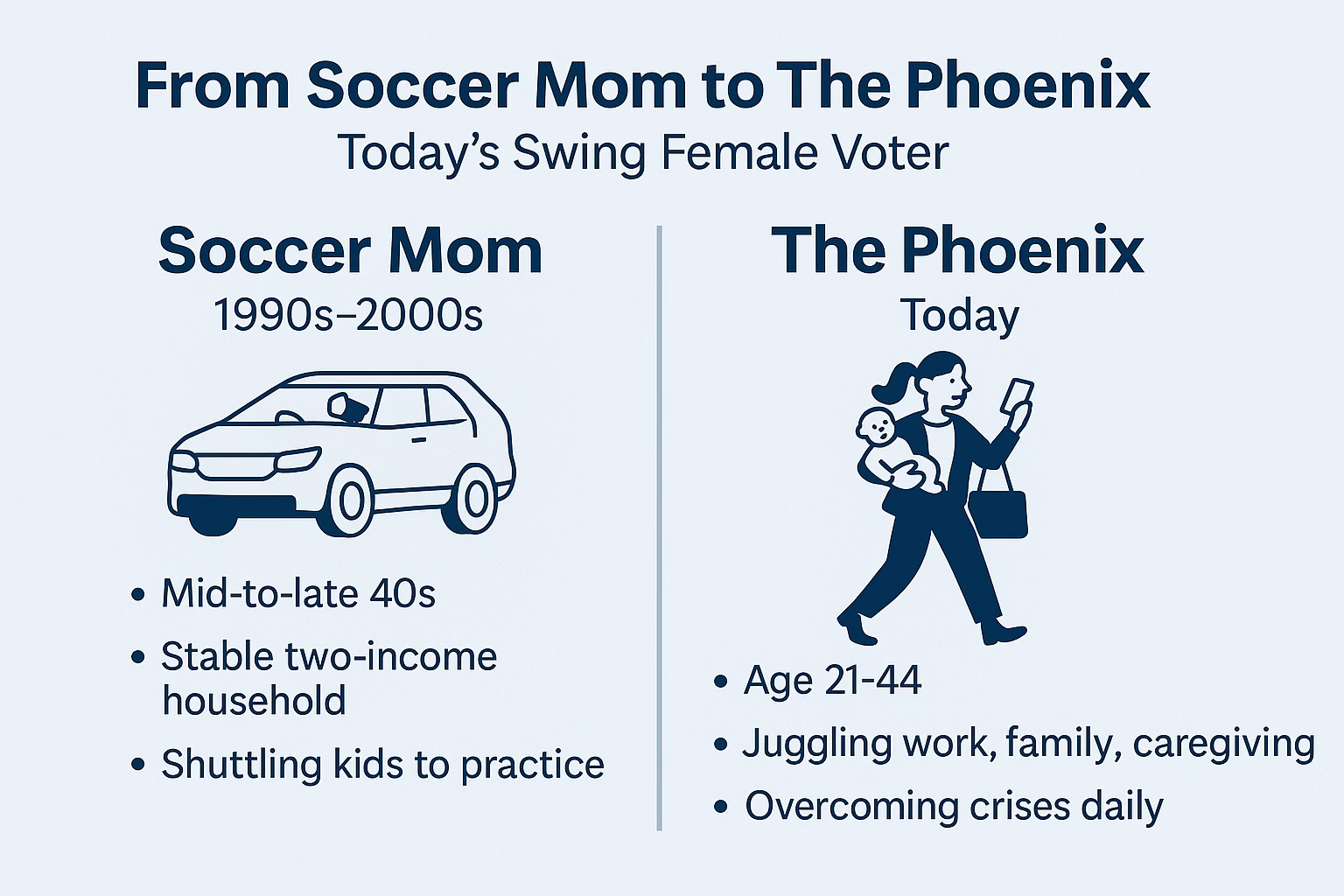
Today’s persuadable is something else entirely. She is The Phoenix — younger, more diverse, and forged in a far tougher America. She’s navigating soaring costs, patchwork childcare, and a gig-and-remote economy without the cushion of a partner’s steady paycheck or a 4% mortgage. Every day is a gauntlet: daycare drop-offs, grocery runs, last-minute client calls, aging-parent care, bills that don’t wait. And yet, she always finds a way.
Demographic Snapshot:
Age: 21–44
Location: Suburban & near-suburban swing zones
Marital Status: As likely to be single as married
Housing: Renting as often as owning
Work: Mix of in-person, hybrid, and gig-based income streams
Education: Often college-educated but not exclusively
Income: She earns too much to be seen as “economically distressed” by Washington think tanks, but her budget is tight enough that every policy change on taxes, energy, child care, or insurance hits hard.
On paper, she looks like a layup for Democrats: educated, suburban women who have leaned blue for years. In reality, the model keeps breaking. In 2024, they tilted toward Trump over Harris in national polling — not out of party loyalty, but from deep skepticism about performance, authenticity, and cost-of-living fixes. They’re not “swing voters” in the old sense; they’re voters with trust issues.
She’s “low-information” and “low-engagement” only in the narrow way political consultants define it — not because she doesn’t care, but because she doesn’t have the bandwidth. The news plays in the background while she gets kids to daycare or preps for a client Zoom. She scrolls TikTok and Instagram for recipes and Facebook Marketplace for secondhand furniture, not for campaign ads.
Lifestyle & Behavior Patterns:
Shops: Target for household runs, Trader Joe’s or Aldi for groceries
Caffeine Fix: Starbucks or boutique coffee house between school drop-off and work
Weekends: Kids’ sports fields, yoga, or catching up on errands
Evenings: Online shopping, streaming, meal prep for the week
Media Diet: TikTok/Instagram, local FB groups, podcasts on the go — not cable news
Pain Points: Rising bills, unreliable childcare, healthcare chaos, safety concerns
The Soccer Mom ran a schedule. The Phoenix runs her life on a mission — solving problems as they arise, reinventing plans mid-flight, and never letting setbacks win. She doesn’t have patience for political theater or ideological point-scoring. If she can juggle work, family, and emergencies and still keep the lights on, she expects government to meet that same standard: fix what’s broken, prove it works, and move on.
It’s the same logic we laid out in It’s the Potholes, Stupid. The pothole is an obvious metaphor. These women aren’t just worried about the road outside their driveway — they want someone to finally fix the deeper cracks: affordable childcare, safer streets, stable health costs, better schools. Until a candidate can prove they’ll deliver those fixes without the theatrics, they’ll keep holding back — even in races they have the power to decide.
This is the 13% sliver of the electorate Zoose has identified as decisive in New Jersey and in every state that matters in 2026. Win her trust, and you don’t just gain a vote — you gain the deciding vote.

🎯 How to Win Them Over
Authenticity – These voters don’t want polished politicians or partisan warriors. They want someone real they can connect with—someone who has moral convictions but remains pragmatic. Authenticity is the bridge to people who’ve tuned politics out.
Get-It-Done Conviction – Our research shows they’re not asking “Who’s left or right?” but “Who will fix broken New Jersey?” The candidate who can deliver practical fixes to affordability, safety, and quality-of-life wins the room.
Prove That Government Can Work – They’re skeptical but not cynical. They believe government could work if run right. Show them proof—visible progress they can feel in their daily lives—and they’ll re-engage. Results speak louder than rhetoric.
🗺️ New Jersey: The Bellwether in Plain Sight
What Zoose is seeing weekly:
Ciattarelli is winning 18–29-year-old men by a mile (Zoose raw composite ~85–15). That tracks with Harvard’s 2025 Institute of Politics study, which found young men nationally have shifted 20+ points rightward since 2016, with fewer than a third now identifying as Democrats. Our raw polling shows an 85–15 Ciattarelli edge among young men — a number that when weighted looks more like 75–25, but still signals a generational shift strong enough to keep Republicans competitive in deep-blue terrain. That single fact keeps this race inside the guardrails for the GOP in a state that hasn’t elected a Republican governor in over a decade.
Sherrill’s path runs through women 21–44 — especially in Bergen, Morris, Essex and Monmouth. The winning pitch is practical: affordability, taxes, schools, safety, health costs. Talk like a human, not a headline.
Why the math is unforgiving:
The bases are locked. A late-July FDU poll had Sherrill 45–37 among likely voters with 16% undecided — almost all in the persuadable zone. Our data, when modeled for voter turnout, suggests a much tighter picture.
Translation: This isn’t about converting hard Rs or Ds. It’s about moving the middle.
🌎 From Jersey to the National Map
That same middle — The Phoenix — isn’t unique to New Jersey. She’s the common denominator in every competitive race on the map. Whether it’s Bergen County or Loudoun County, Morris or Cumberland County, Monmouth or Wake County, she’s weighing the same questions: Can I afford to live here? Is my family safe? Do I believe this candidate will actually fix anything?
That’s why Zoose isn’t just tracking New Jersey’s governor’s race. We’re running the same voter model through other bellwether battlegrounds and one high-profile city test case:
Virginia — Can Democrats hold the suburbs when the young-male rightward shift softens but doesn’t disappear?
Maine — Can a pragmatic independent brand still pull persuadables when the base is restless?
North Carolina — Can a Democrat bridge urban progressives and suburban swing women in a lean-red state?
New York City (Case Study) — What happens when emotional progressives are fully engaged and turnout is surging?
The answers in those places will feed directly back into New Jersey — because the same voter decides them all.
🗳️ Virginia: The Male Break Softens, Not Disappears
The matchup: Winsome Earle-Sears (R) vs. Abigail Spanberger (D). Two women at the top changes the visual, but not the fundamentals.
Latest VCU/Wilder poll: Spanberger 49–37 (+12), riding on crossover credibility, calm tone, and a united base.
In Fairfax and Loudoun, the young-male rightward drift exists but is muted without a polarizing male foil.
The progressive factor here mirrors the bellwether lesson from Jersey:
No active progressive–centrist war means Spanberger keeps the emotional progressives fully engaged.
Emotional progressives are present but not dominating the conversation, allowing her to keep focus on cost-of-living, schools, and abortion access — her strongest ground.
When the left isn’t fighting the center, Democrats hold their coalition and keep persuadables in play.
🌊 Maine: Bellwether Lessons, RCV Rules
Susan Collins is running for re-election in 2026 — and for the first time in decades, she starts the cycle with real vulnerabilities. Morning Consult’s latest quarterly survey has her at 38% approval, 54% disapproval — the lowest since the poll began tracking her in 2017. That’s a collapse from 47/44 just two quarters ago and a sharp contrast to the 50%+ favorables she carried into her 2020 win. Other recent polls tell the same story: UNH has her at 14% favorable / 57% unfavorable, with 26% neutral. Even the friendliest measure, Pan Atlantic, puts her at 49/45 — still underwater for a Maine incumbent.
Maine uses Ranked Choice Voting (RCV) in federal general elections, which means Collins doesn’t have to win a majority on the first count — but she must remain competitive as a second-choice option if progressives and Democrats split early-round votes. That’s been a safety net in past cycles; in 2026, it’s a necessity.
Progressive influence here is real but localized — Portland’s urban core, its close-in suburbs, the Bangor/Lewiston corridor, and university towns. Emotional progressives can turn those areas into turnout engines, but the decisive bloc in Maine, as in New Jersey, is the pragmatic persuadable: independents (disproportionately female, 21–44, and suburban/near-suburban) who reward competence over combat.
Why NJ is the bellwether for ME:
Persuadables decide it. In Jersey, women 21–44 in the suburbs are the fulcrum; in Maine, it’s persuadable independents who want tangible fixes to affordability, healthcare, childcare, and rural infrastructure.
Tone beats tribe. Jersey shows that authenticity and practical results unlock the ~13% in play. Collins’ path mirrors that: low drama, bipartisan branding, and local results.
Base + beyond. Jersey warns Democrats: mobilize the left and comfort the middle. In Maine, RCV lets the left “vote their heart” first — but if those votes don’t transfer cleanly to the Democrat in later rounds, Collins can still edge out a win.
The map right now: Democrats have two declared candidates — David Costello and Jordan Wood — but no marquee challenger. Governor Janet Mills is viewed as the strongest potential contender but hasn’t announced.
Don’t rush to count out Collins. As Amy Walter of the Cook Political Report noted, the “red lights are really blaring in Maine” for Republicans — but she also flagged the absence of a top-tier Democrat willing to commit. Larry Sabato’s Crystal Ball still rates the race Lean Republican, and for good reason: Collins has a long history of defying bad polling, most notably in 2020 when she trailed Democrat Sara Gideon in nearly every public survey yet won re-election with just over 50% of the vote. She’s weathered political storms before — often turning late-breaking momentum and her independent brand into narrow but decisive victories.
This is a perfect example of voter sentiment in the moment versus real GOTV on the ground.
🐏 North Carolina: South Jersey Redux
North Carolina’s 2026 U.S. Senate race is now fully underway. With retiring GOP Sen. Thom Tillis out, Democrats have recruited former Governor Roy Cooper — a proven statewide vote-getter — to run for the seat. On the Republican side, sitting RNC Chair Michael Whatley has jumped in, giving the GOP a high-profile, Trump-aligned candidate.
The backdrop matters: In the 2024 presidential election, Donald Trump carried North Carolina by 3.2 points (51.0% to Kamala Harris’s 47.8%), a wider margin than his 2020 win. That result confirmed NC’s lean-red tilt in statewide races and showed the GOP’s ability to hold its ground even in high-turnout years.
North Carolina doesn’t have a statewide progressive machine like New Jersey or New York, but it does have concentrated pockets of progressive energy — in places like Durham, Chapel Hill, and Asheville — that can matter in a close race. These voters are a mix of “emotional progressives” who rally around big-issue fights and pragmatic progressives who turn out when they believe their vote will deliver real change.
Early Emerson polling shows Cooper leading Whatley 47% to 41%, with 12% undecided — a map that looks strikingly like New Jersey’s in its balance of suburban persuasion and base mobilization. The lesson from Jersey? Cooper’s path isn’t just about holding the Democratic base; it’s about winning over 21–44-year-old suburban women and convincing those urban progressives the race is worth showing up for.
If Cooper can keep the suburbs competitive and give the progressive pockets a reason to believe — with tangible, everyday fixes — he can outflank Whatley. If not, a Republican with a strong young-male base could keep the fight razor-close. North Carolina is South Jersey — just with smaller blue islands in a bigger red sea.
NYC: When the Left Is Fully Lit 🔥
While New Jersey’s emotional progressives are lukewarm, New York City’s left is ablaze. Zohran Mamdani’s mayoral campaign has sparked a full progressive surge, with ranked-choice polling showing him beating Cuomo head-to-head in a four-way race—and holding a clear lead even after transfer votes, with undecideds under 6%. This isn’t low-turnout idealism: it’s kinetic voter energy translated into a real advantage.
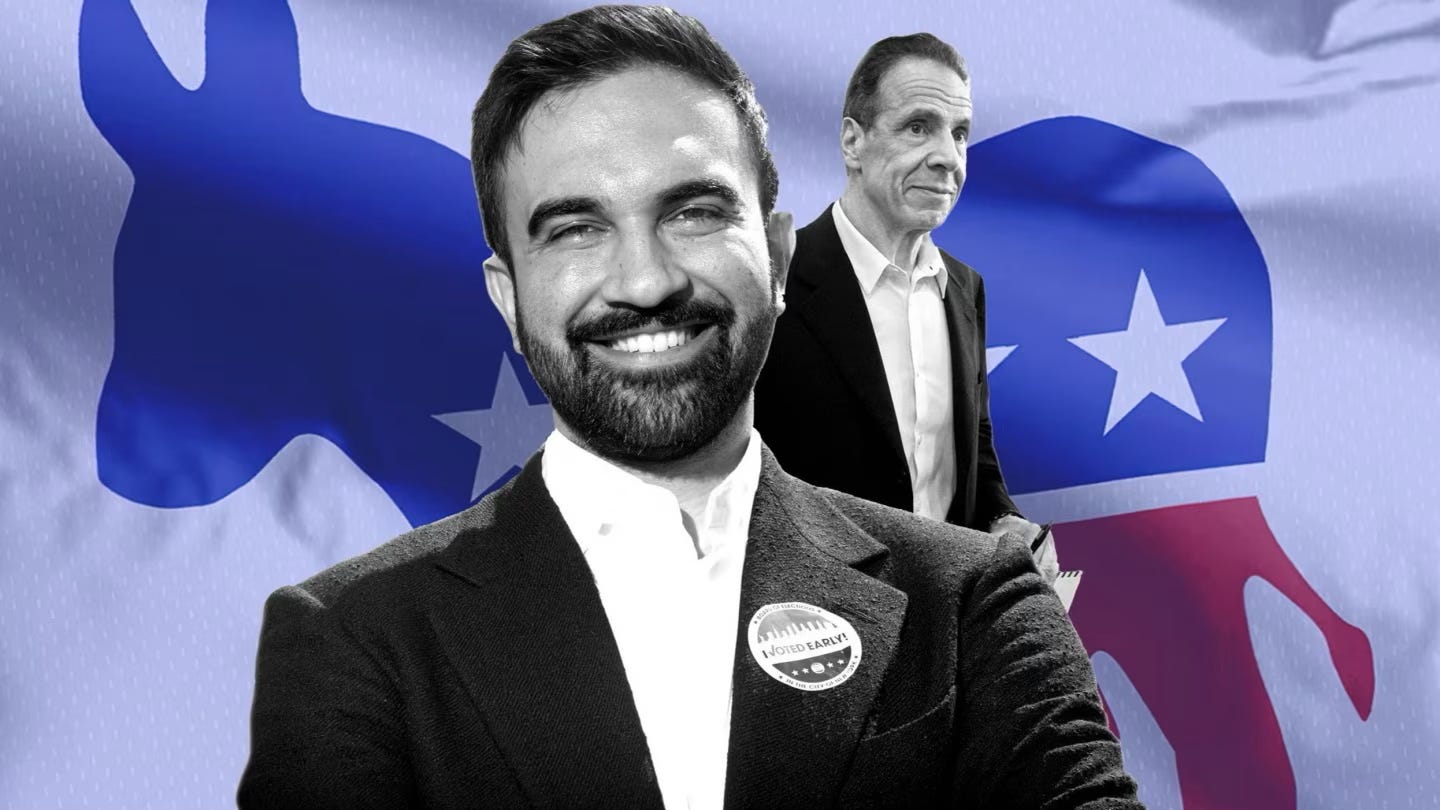
That’s the payoff when emotional progressives see a fight worth fighting. Voter turnout ricochets upward, the left unifies, and moderates are drowned out by passion and momentum. The contrast with New Jersey is telling. In NYC, the progressive fire is a bonfire. In New Jersey, it’s barely flickering—and that makes all the difference.
If NYC’s mayoral general election were held today
Mamdani: 38.1%
Cuomo: 25.0%
Sliwa: 15.0%
Adams: 11.5%
Walden and others: ~1%
(Source Decision Desk HQ August Mayor Ballot Test Likely Voters)
For Cuomo, the math is brutal but simple. The latest poll shows him ahead of Mamdani in a direct one-on-one by a single point— but trailing badly in a four-way race where Curtis Sliwa and Eric Adams siphon critical moderate and crossover votes. Unless he can clear the field and force a true head-to-head, the progressive bloc’s unity will overpower his fractured coalition. In a city where passion is translating directly into turnout, consolidation isn’t just a strategy — it’s his only shot.
🎯 Conclusion: Four States, One Voter
From Montclair to Fairfax, Portland to Raleigh, the same voter decides it all — The Phoenix, not even remotely a political junkie, but instantly alert when the message impacts her daily life.
New Jersey is the proving ground for the fight for her.
Win her, you win the race. Lose her, and no amount of base turnout will save you.
What happens in Jersey doesn’t stay in Jersey.
It spreads — fast.
Where Progressives Matter
On Newsmax this week, I laid out a point that Rahm Emanuel missed entirely on CNN’s Smerconish. In an effort to shift focus — or minimize the impact of progressives on the Democratic Party — he argued that moderates Mikie Sherrill and Josh Gottheimer combined for more votes than progressives Steven Fulop and Ras Baraka in New Jersey’s June primary, proof, in his view, that the progressive wing is losing steam.
The problem? His math was wrong. He left out Sean Spiller — a progressive through and through — whose totals, when added to Fulop and Baraka, actually outpaced the moderates.
That’s the reality: the progressive movement in New Jersey isn’t shrinking — it’s reshaping. But in NYC’s media shadow, left-of-left narratives bleed across the Hudson. Great for urban primary energy, not great for swing-suburban persuasion.
If the general is framed as “insurgent purity vs. establishment suits,” persuadable women tune out and young men galvanize right.
Unless Sherrill can ignite the “emotional” progressives without alienating the middle—like her friend Abigail Spanberger has done in VA—she risks the same turnout drop-off we’ve seen elsewhere.
Which Harry Should We Believe?
The House Generic Ballot Whiplash
Just two weeks ago, CNN’s Harry Enten was sounding the warning siren for Democrats. He reported that the House generic ballot sat at D+2, down sharply from D+7 in mid-July two years earlier. Alongside a Cook Political Report projection of +12 seats for Republicans, the message was clear: Democrats had reason to worry heading into the 2025–2026 cycle. The tone was almost clinical — if trends held, Republicans were positioned to take back momentum.
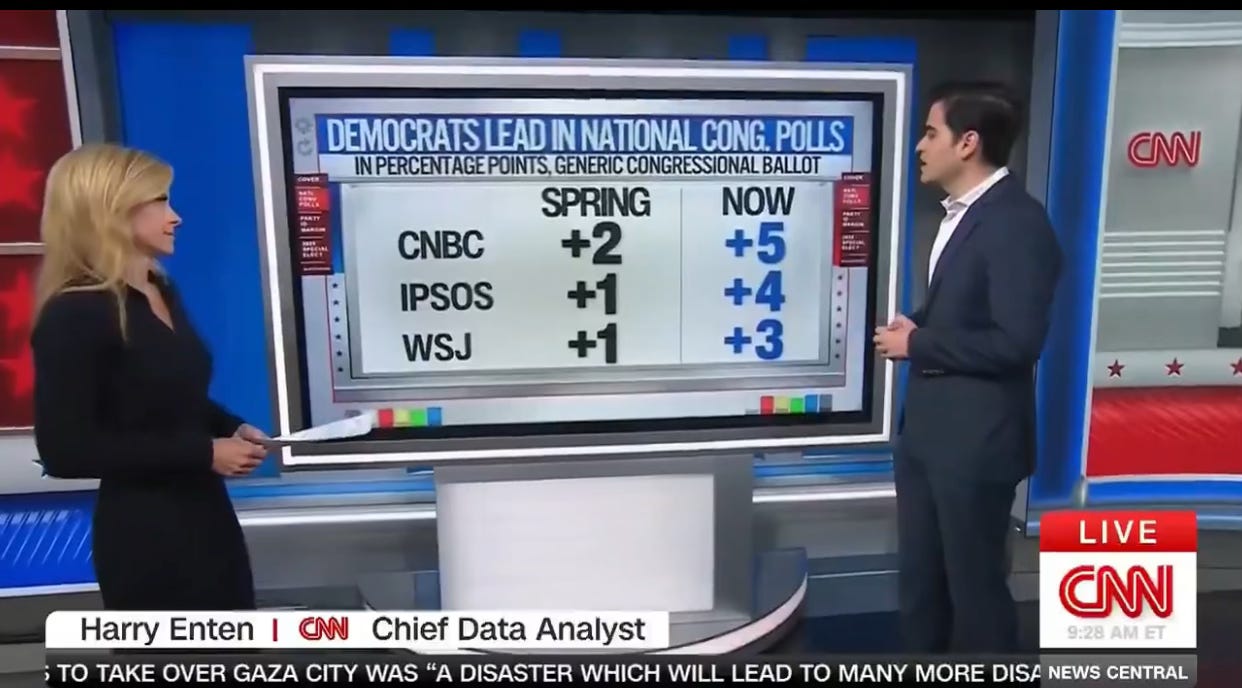
Fast forward fourteen days, and the narrative has completely flipped. This week, Enten is pointing to three separate data points that now spell trouble for Republicans:
Generic Congressional Ballot –
CNBC: D+2 in spring → D+5 now.
Ipsos: D+1 → D+4.
WSJ: D+1 → D+3.
Average: D+4 — up from just about +1, a three-point Democratic gain in short order.
Party Identification –
Quinnipiac: GOP +1 in Q1 → D+4 now (+5 shift toward Democrats).
Gallup: Dead heat earlier → D+3 now.
Special Elections –
In median 2025 specials, Democrats are running +13 points better than the same districts in 2024 — a dramatic reversal from last year, when Republicans were consistently outperforming Biden’s 2020 baseline.
So which Harry Enten should we believe — the one warning Democrats two weeks ago that the winds were shifting away from them, or the one today waving the “Uh-oh” flag for Republicans?
The truth is, both could be right — and both could be wrong — depending on how you read the cycle’s volatility. None of the polls Enten is citing — like CNBC’s 1,000-Americans sampled — use a likely-voter screen in the generic House ballot. That means they’re measuring sentiment in the moment, not modeling for who will actually show up in 2026. As Zoose’s models show, topline enthusiasm shifts can evaporate once the likely-voter filter kicks in — especially when the key persuadable blocs remain unconvinced.
And here’s the kicker: going into this November, it’s also a flashing warning sign for Democrats. In the same CNBC survey where they lead Republicans 49–44 on the generic ballot, their overall net favorability sits at –32 — the lowest CNBC has measured for either party since 1996, with 54% of independents viewing them negatively. That’s the kind of number that can erase a ballot advantage overnight once the likely-voter screen kicks in.
🧮 ZPI Rankings – Week 28

🐘 Jack Ciattarelli 🚫 0.0% 📍 ZPI Score: 92.0
🐴 Mikie Sherrill 🚫 0.0% 📍 ZPI Score: 91.8
The race remains a base-vs.-persuasion stalemate. VBM is a little more than a month away, but the good news for both campaigns, The Phoenix will not be voting until November—when she can find the time.
A special thank you this week to veteran political reporter and reader of Zoose Political Index, Fred Snowflack, for an unexpected twist in my week. I went to Boonton to have coffee with him, and the next thing I knew, the shoe was on the other foot — I was the one being interviewed. Fred captured my journey over the past several years with insight and care, and I think he did a great job for Insider NJ.
From Political Candidate to Political Forecaster: The Journey of Patrick Allocco
🔥 8 Minutes a Week with ZPI = More Political Insight Than Most Insiders.
🔹 About Zoose® and Patrick Allocco
Zoose® is an award-winning technology company founded by Patrick Allocco, a veteran campaign operative and former Congressional candidate. Built on multi-patented AI and human-to-human communication tools, Zoose solves real-time challenges across industries—from global support services to political intelligence.
At the forefront of its civic innovation is the Zoose Political Index (ZPI)—a nonpartisan, AI-powered election analysis platform that delivers weekly rankings, turnout modeling, and data-driven insights. ZPI has become a trusted source for understanding the evolving dynamics of the 2025 New Jersey Governor’s race and soon beyond.
Patrick Allocco has advised and worked on campaigns at every level—State Senate, Congress, U.S. Senate, gubernatorial, and Presidential—giving him a uniquely practical perspective on voter behavior and strategic messaging. His experience in field operations and coalition-building fuels Zoose’s mission to cut through the noise with clarity, accuracy, and impact.
In 2024, Allocco was recognized in Who’s Who in America for U.S. Technology for his contributions to innovation and AI driven solutions.