
New Jersey's Lightbulb Moment
Why Skyrocketing Electric Bills Could Be the Sleeper Issue of 2025

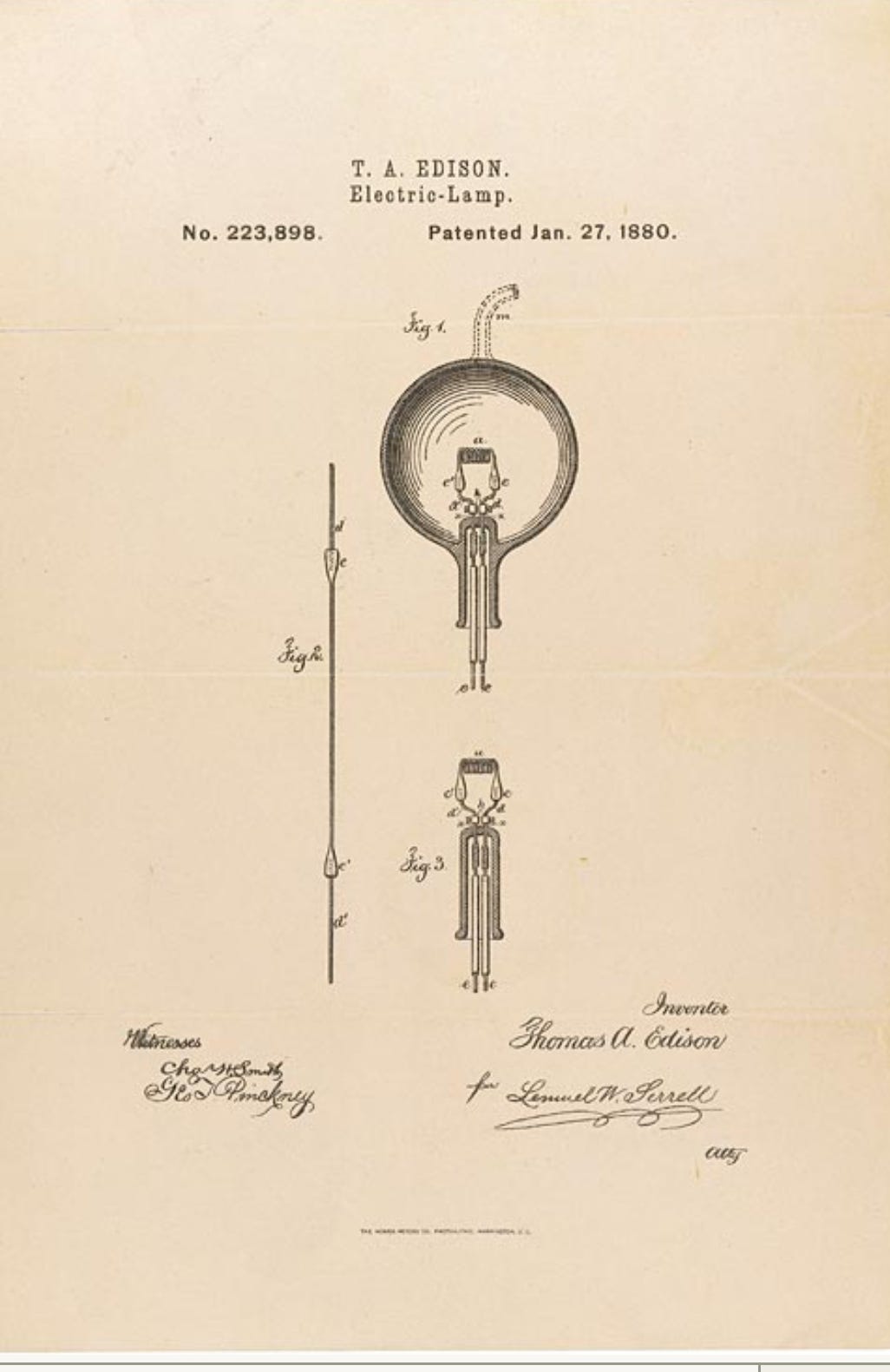
Thomas Edison gave the world the lightbulb right here in New Jersey.
Now, nearly a century and a half later, the state that invented light is being dimmed by skyrocketing electric bills — and this time, it’s not just a utility story. It’s an affordability crisis with the potential to jolt the governor’s race. Affordability has been the number one issue in this race — and in every major poll to date. Weeks ago, we called it in It’s the Potholes, Stupid: voters aren’t driven by abstract policy, they’re driven by what hits their wallets and daily lives. High electricity costs? That’s a pothole issue. And pothole issues decide elections.
But here’s the catch: the pain is real, the salience is high, and the trust gap is wide.
How We Got Here
In 2018, Governor Phil Murphy’s administration shut down the Oyster Creek nuclear power plant in Forked River — the oldest in the country — before replacing its generation capacity. That plant supplied roughly 40% of New Jersey’s nuclear energy and a significant share of the state’s total baseload power.
Murphy then moved aggressively to shutter coal plants, taking more steady, on-demand generation offline. What didn’t come online fast enough were the replacements — especially for nights, cloudy days, or when the wind doesn’t blow.
Dan Lockwood, spokesperson for PJM Interconnection (the regional grid operator), didn’t sugarcoat the consequences. He told the New Jersey Monitor:
“These higher prices are the result of a loss in electricity supply caused primarily by decarbonization policies that have led to an uptick in generator retirements.”
He added that New Jersey’s prices were further driven by “an unprecedented spike in electricity demand” from AI data centers, the rapid expansion of electric vehicles, and the state’s own green-appliance push.
Translation: We are using more electricity than ever — after dismantling much of the infrastructure that used to supply it.
Why This Is Phoenix Fuel
The Phoenix voter — our shorthand for the 21–44-year-old suburban persuadable woman — doesn’t read PJM capacity reports or debate nuclear vs. solar on X (Twitter). She’s balancing a mortgage or rent, childcare, groceries, and gas. And now her electric bill — once about $300 — is suddenly hundreds higher.
In one well-publicized case, a PSE&G bill jumped from roughly $300 to more than $1,000 this summer — rare, but potent as a symbol. More typically, households saw 17–20% hikes starting in June, with PJM’s supply-auction costs adding at least $20 a month beginning mid-2025.
She’s not ideological. She’s not scanning MSNBC or Fox for talking points. She’s on TikTok, Facebook, and Instagram — swapping screenshots of bills, tagging friends, venting in neighborhood groups. In those threads, neighbors are connecting the spike to Murphy’s policies — and to Mikie Sherrill’s support for that same agenda.
For her, this isn’t “energy transition policy.” It’s whether she can afford back-to-school shopping without putting it on a credit card.
The Online Chatter Surge
In the past two weeks, Zoose social media monitoring has picked up a sharp uptick in electricity-bill chatter:
TikTok: Clips of residents opening PSE&G bills with captions like “THIS IS INSANE” drawing hundreds of thousands of views.
Facebook: Local groups swapping screenshots and comparing percentage jumps.
X (Twitter): Commentary tying Oyster Creek’s closure and Murphy’s energy policy to current rates — with Sherrill tagged directly.
This isn’t partisan online. It’s personal. That’s why it’s breaking through — but it’s also why neither side can take ownership for granted.
What Our Data Says
This week, Zoose ran four issue-specific polls asking the same question with minor variations: “Who do you trust more to fix New Jersey’s high electricity costs?” The first poll narrowly boosted to 100% women ages 21–39, the others left to the broader platform audience of likely NJ voters. Each produced very different toplines. To cut through the noise, we’ve weighted the results to reflect New Jersey’s electorate more accurately.
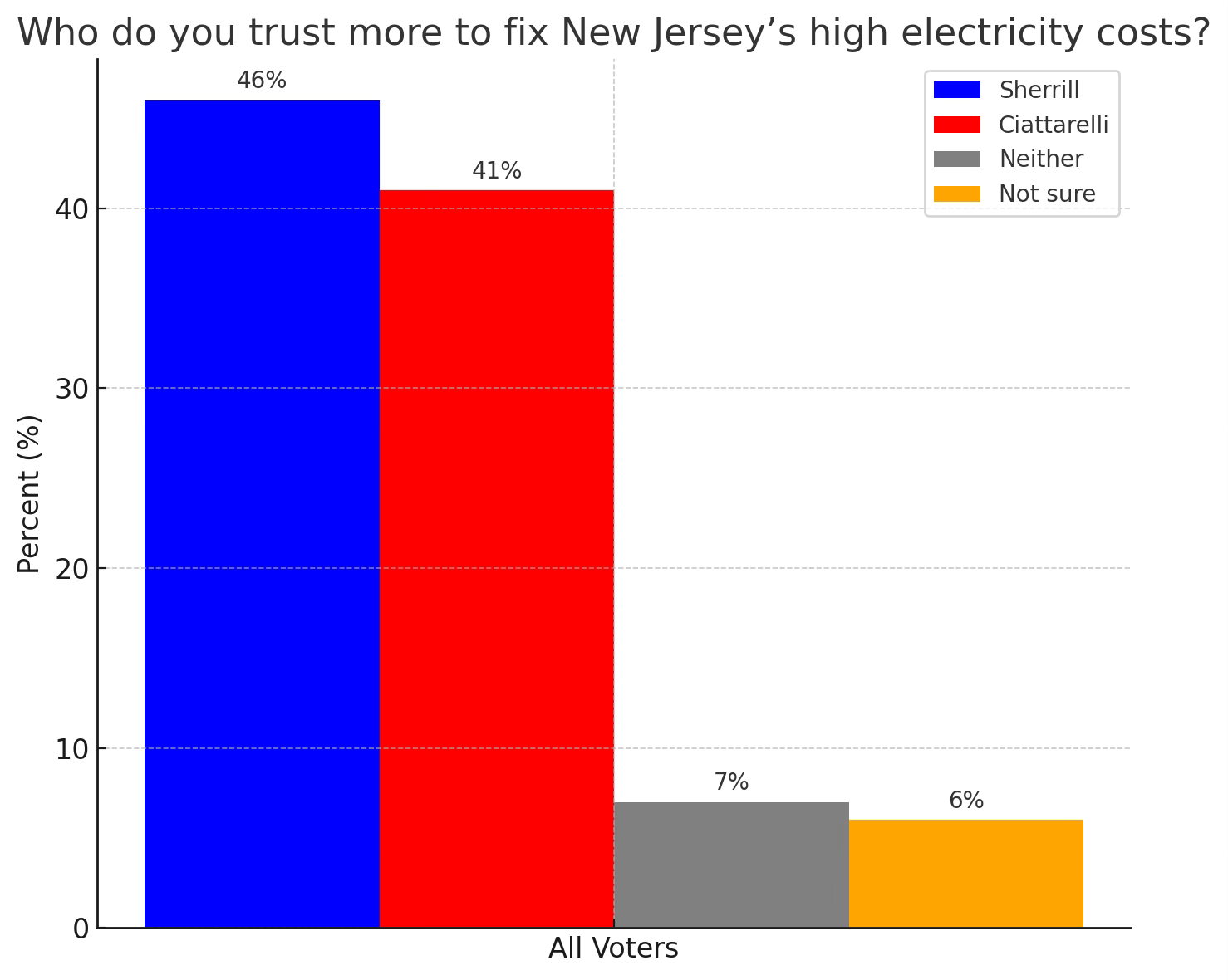
➡️ Sherrill holds a 5-point lead on the question of who voters trust more to fix New Jersey’s electricity costs.
Why it matters
Engagement levels – These respondents are not our “Phoenix persuadable voters” (low-information, low-engagement). They’re the opposite: highly engaged, high-information voters, many of whom have already made up their minds.
✅ Engagement Metrics
Views: ~70,000
Engagements: ~3,900
Engagement Rate: ~5.6% —That’s a huge volume for an issue-specific affordability question.
That makes the 13% undecided figure even more striking — if the most tuned-in voters are split, the undecided share among lower-information persuadables is almost certainly higher.
Demographics –
Across all polls combined, two-thirds of impressions came from 20–29-year-olds, with another 18% in the 30–39 range.
Gender skewed ~66% male / 34% female, a reminder that platform noise leans male, even when boosts are targeted.
Sherrill dominates among highly engaged women 21–39, but the real question is whether that strength translates to the disengaged women 21–39 who aren’t showing up in polls. Those are the persuadables both campaigns need to reach.
Message framing – When framed as “lower your family’s bills”, Sherrill’s numbers surged. When framed generically as “fix NJ’s electricity costs”, the race tightened, with Ciattarelli gaining ground. This shows message nuance isn’t cosmetic — it changes who voters trust.
The Takeaway
Sherrill currently owns the “problem-solver” mantle on affordability, especially with suburban (non-Phoenix) women ages 21–39. But those respondents are high-information, high-engagement voters — not the low-information persuadables who will actually decide the race. The true persuasion zone isn’t showing up in these polls.
Among highly engaged voters, many minds are already made up, but the 13% undecided share on this issue proves trust is still up for grabs.
For Ciattarelli, the opening is clear: electricity costs cut across partisan lines, but right now he hasn’t claimed ownership of the issue. Unless he makes a direct and credible play on affordability, Sherrill’s renewable energy credibility and her ability to frame the problem around household budgets could lock in a critical advantage. If that happens, she won’t just lead on the issue — she’ll define the affordability conversation in a way that Ciattarelli can’t easily recapture.
The Political Power Grid
Jack Ciattarelli isn’t tied to Murphy’s clean-energy mandates. Mikie Sherrill is. She didn’t sign the shutdown order, but she’s aligned herself with Murphy’s climate and energy vision. If Sherrill can distance herself from the pain and offer her own affordability plan, she can neutralize the threat.
The Phoenix voter doesn’t parse “direct responsibility” from “policy supporter.” She asks:
Who’s in office?
Who’s supported the policies that led to this?
Who can fix it?
Right now, our data suggests that bloc is still open to either candidate’s answer on affordability — but time is running out quickly.
Week 29 Rankings
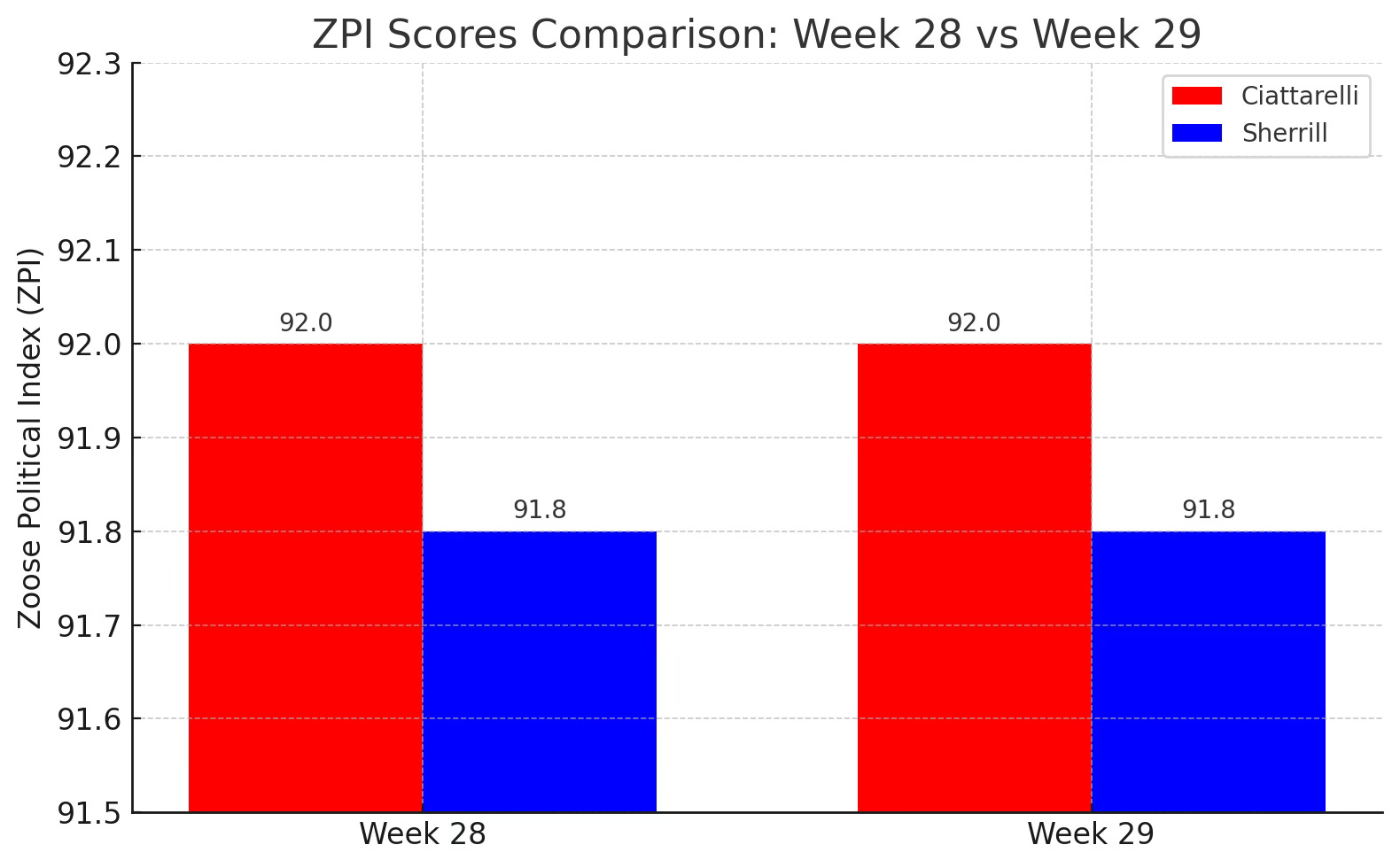
Sometimes the smartest move is no move — and right now, New Jersey’s governor’s race is frozen in place, like an overheated grid in the dead of August heat.
While we’re holding steady, that’s precisely why our model has been weeks ahead of traditional pollsters — they’re only now catching up to where Zoose has already been. Think of it like the grid: we spotted the surge early, while others are still adjusting their dials. By next month, their four- to six-point gaps will narrow to within a couple of points — right where we’ve been all along.
Conclusion
When Thomas Edison invented the lightbulb here, it was a symbol of progress.
Today, New Jersey’s electric bills are a symbol of broken priorities — but they’re also a political prize still up for grabs. Whoever convinces the Phoenix voter they can keep the lights on without emptying her bank account may just win the Governor’s race.
Transparency or Tactical Armor?

On August 14, The New Jersey Globe ran what amounts to a political inoculation piece for Mikie Sherrill — framing her detailed financial disclosure as proof she’s “gone beyond” what the law requires.
The timing is no accident: it comes after weeks of “Mikie Made Millions” attacks from the Ciattarelli campaign and allied PACs, including claims she benefited from stock trades during her time in Congress. The Globe piece leans heavily on the narrative that her wealth stems primarily from her husband’s Wall Street earnings and that she holds no individual stocks — but notably avoids a line-by-line rebuttal of past accusations or questions about trade timing before her ETF conversion.
If this feels familiar, it’s because we flagged this exact vulnerability — and the digital tactics that could exploit it — a month ago.
From our July 14 analysis: we outlined a hypothetical turnout-suppression playbook — a Ciattarelli-aligned PAC using Gen Z lifestyle influencers on TikTok to push the idea that Sherrill personally profited from $7 million in stock trades. The goal wouldn’t be to win votes, but to erode trust and dampen turnout among disillusioned young progressives by contrasting aspirational imagery with the message that “no politician is clean.”
The August 14 release is essentially Sherrill’s countermeasure to that kind of message before it fully takes root. By publishing exact dollar amounts and reframing the origin of her wealth, she’s giving her surrogates and editorial boards a ready-made “transparency” talking point to blunt the impact of a disillusionment campaign.
But as we noted then — and still believe now — the potency of this tactic isn’t tied to whether the accusation is true. It’s tied to whether the voter feels like politicians profit while ordinary people struggle.
🔥 8 Minutes a Week with ZPI = More Political Insight Than Most Insiders.
🔹 About Zoose® and Patrick Allocco
Zoose® is an award-winning technology company founded by Patrick Allocco, a veteran campaign operative and former Congressional candidate. Built on multi-patented AI and human-to-human communication tools, Zoose solves real-time challenges across industries—from global support services to political intelligence.
At the forefront of its civic innovation is the Zoose Political Index (ZPI)—a nonpartisan, AI-powered election analysis platform that delivers weekly rankings, turnout modeling, and data-driven insights. ZPI has become a trusted source for understanding the evolving dynamics of the 2025 New Jersey Governor’s race and soon beyond.
Patrick Allocco has advised and worked on campaigns at every level—State Senate, Congress, U.S. Senate, gubernatorial, and Presidential—giving him a uniquely practical perspective on voter behavior and strategic messaging. His experience in field operations and coalition-building fuels Zoose’s mission to cut through the noise with clarity, accuracy, and impact.
In 2024, Allocco was recognized in Who’s Who in America for U.S. Technology for his contributions to innovation and AI driven solutions.