
The Blue Mushburger
Surf’s Up? Before Democrats can ride the wave, they have to prove it can break.

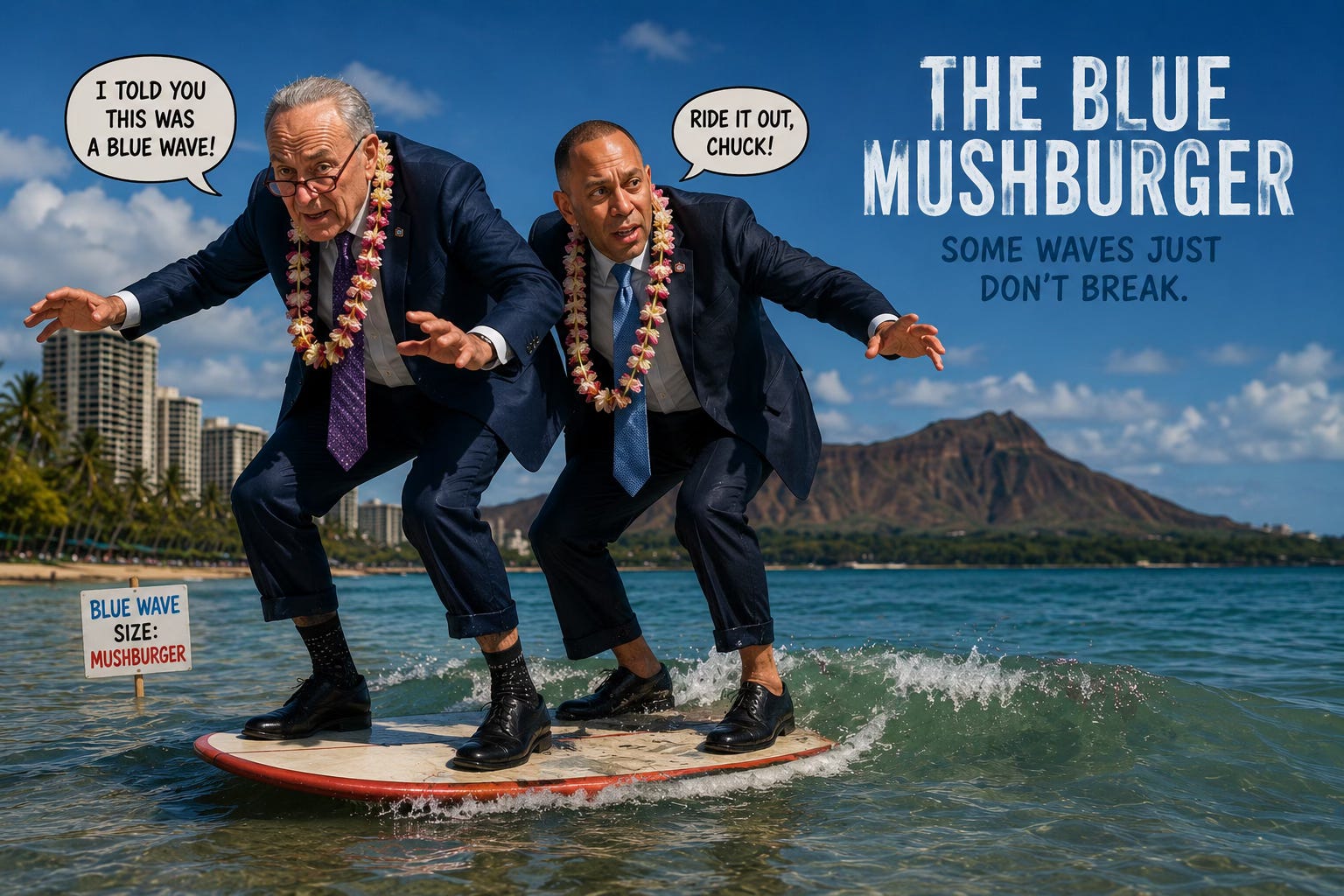
Surf’s up.

Picture the scene: Southern California, mid-1960s. Woodies lined up by the sand. AM radio humming “Catch a Wave” from a beach blanket — which, as it turns out, is exactly what Democrats are trying to do.
A longboard tucked under one arm. The sun is high, the water is glassy, and every kid on the shoreline is watching the horizon, waiting for the big one to roll in.
At first, you see it.
A swell.
A little lift in the water.
Enough movement to make everyone stand up and point.
For a moment, it looks like something.
Maybe this is the one.
Maybe this is the wave.
But surfers know the difference between a real breaker and a mushburger.
A mushburger is the tease.
It rises, it rolls, it promises. It has motion. It has energy. It even looks rideable from a distance.
Then it gets close.
And instead of curling into a clean, powerful break, it flattens, softens, and loses its shape before anyone can really ride it.
That may be the best way to understand the current Democratic “blue wave” theory.

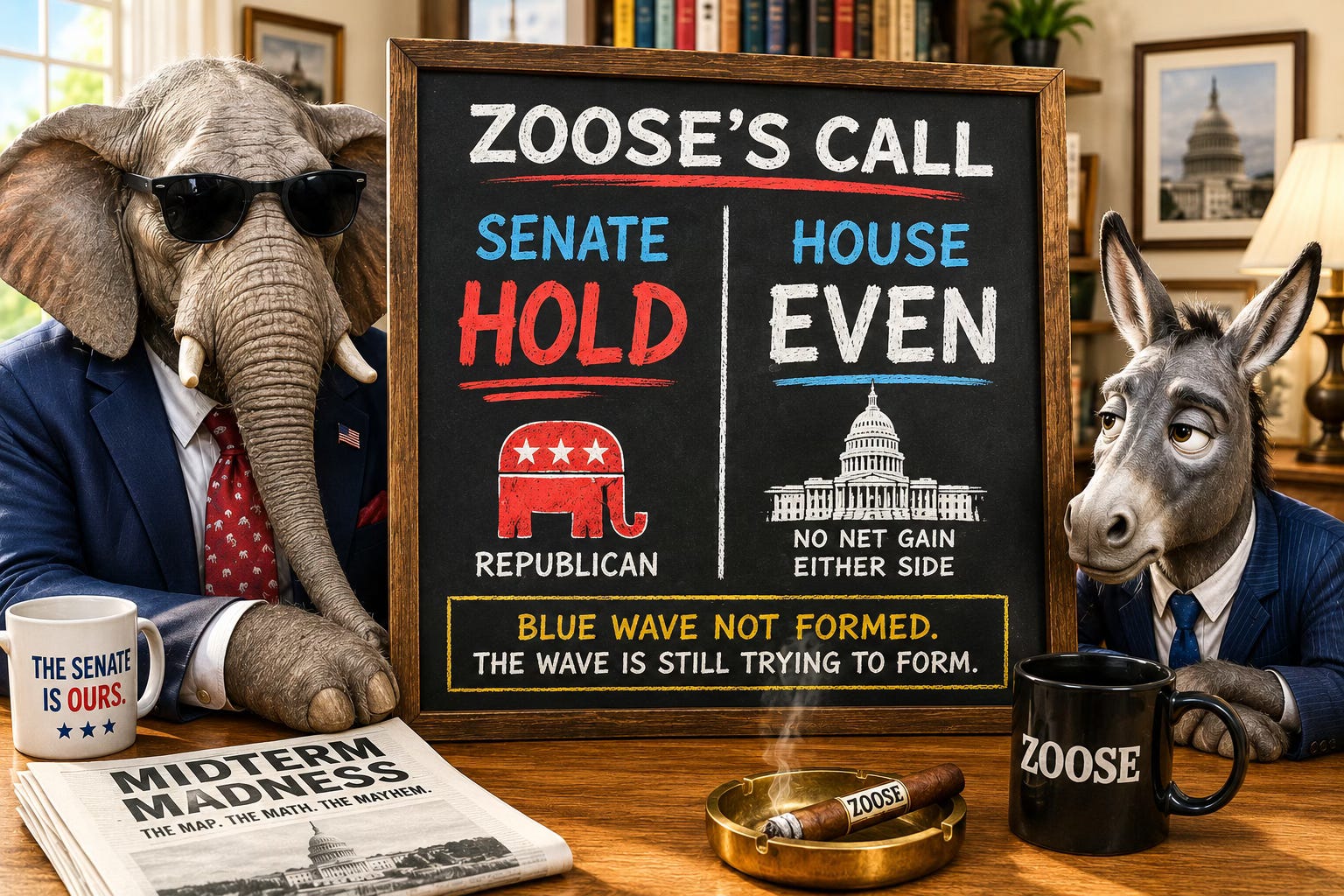
Last week, in Midterm Madness, Zoose warned that the blue-wave narrative was missing the math in the map.
Democrats may have the national mood. President Trump may be underneath the blue wave on affordability. The generic ballot may be leaning ever so slightly Democratic.
But the House is not elected nationally.
It is elected district by district, through maps that are being redrawn, challenged, hardened, and litigated in real time.
This week, the map answered back.
Cook Political Report moved 12 House race ratings because of redistricting developments in Virginia, Tennessee, and Florida.
Eleven of those 12 moves shifted toward Republicans.
As we predicted, the Virginia Supreme Court struck down the $100M Democratic-backed redistricting plan, ruling that the process used to advance it violated the state constitution.
The rejected map could have shifted as many as four House seats away from Republicans, making the decision a major setback for Democratic hopes of offsetting Republican redistricting gains elsewhere.
And Virginia was one of the biggest Democratic counterweights in the redistricting arms race.
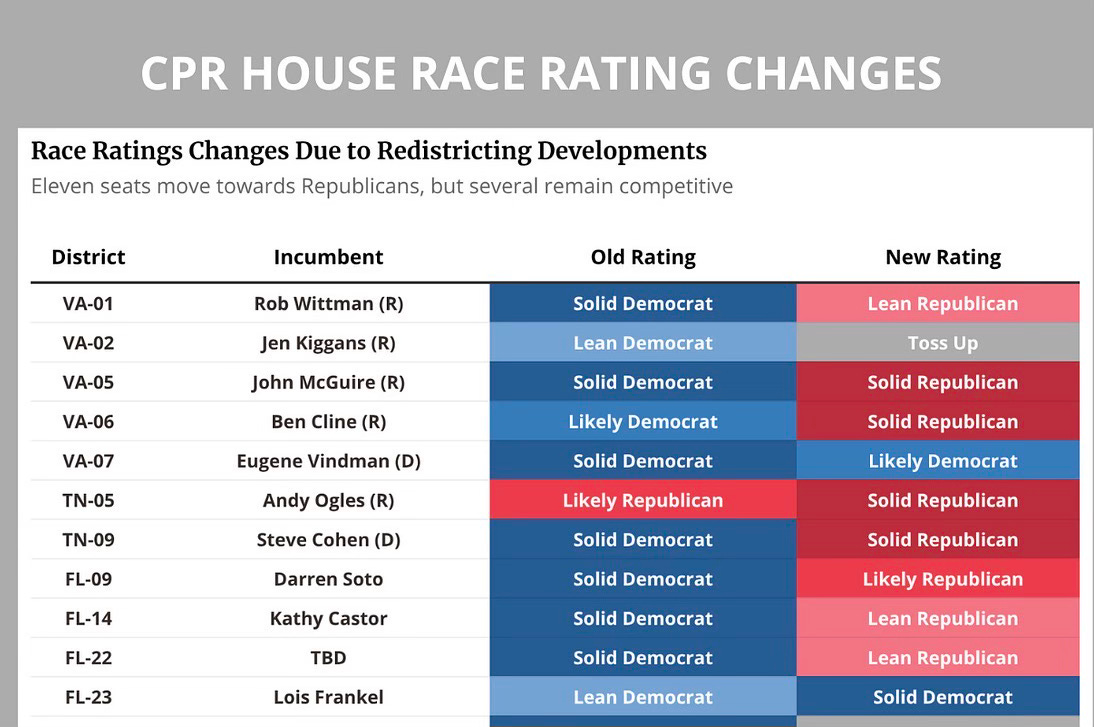
While this doesn’t mean Republicans just gained 11 seats.
It does means the playing field moved right — exactly the conversion problem that Zoose identified last week.
While pundits were reading national mood. Zoose was reading the map.\
TikTok Validation
Even progressive watchdogs are now tracing the same math.
Nico, who runs Stocking the Capitol on TikTok and tracks PAC money and congressional power, laid out the redistricting chain this week almost exactly the way Zoose framed it in Midterm Madness.
Texas moved first, adding Republican seats.
Missouri followed.
North Carolina followed.
Utah moved in the other direction.
California answered Texas.
Florida then moved right.
Virginia tried to move left — and then the state Supreme Court struck it down.
Louisiana, Alabama, Tennessee, and South Carolina are now part of the post-Callais scramble.
His point was not subtle: this is no longer a normal election cycle. States are changing the battlefield while campaigns are already underway, and in Louisiana’s case, after voters had already started casting ballots in congressional primaries.
That is the part voters feel instinctively even if they do not follow every district line.
The ground is moving.
The House fight is not just being contested at the ballot box. It is being contested in legislatures, courts, commissions, ballot measures, and emergency sessions.
And that is why the blue-wave theory keeps running into the same problem.
A national mood can rise.
But if the map shifts underneath it, the wave loses shape before it reaches shore.
The Pollsters
Quantus Insights landed in a similar place this week.
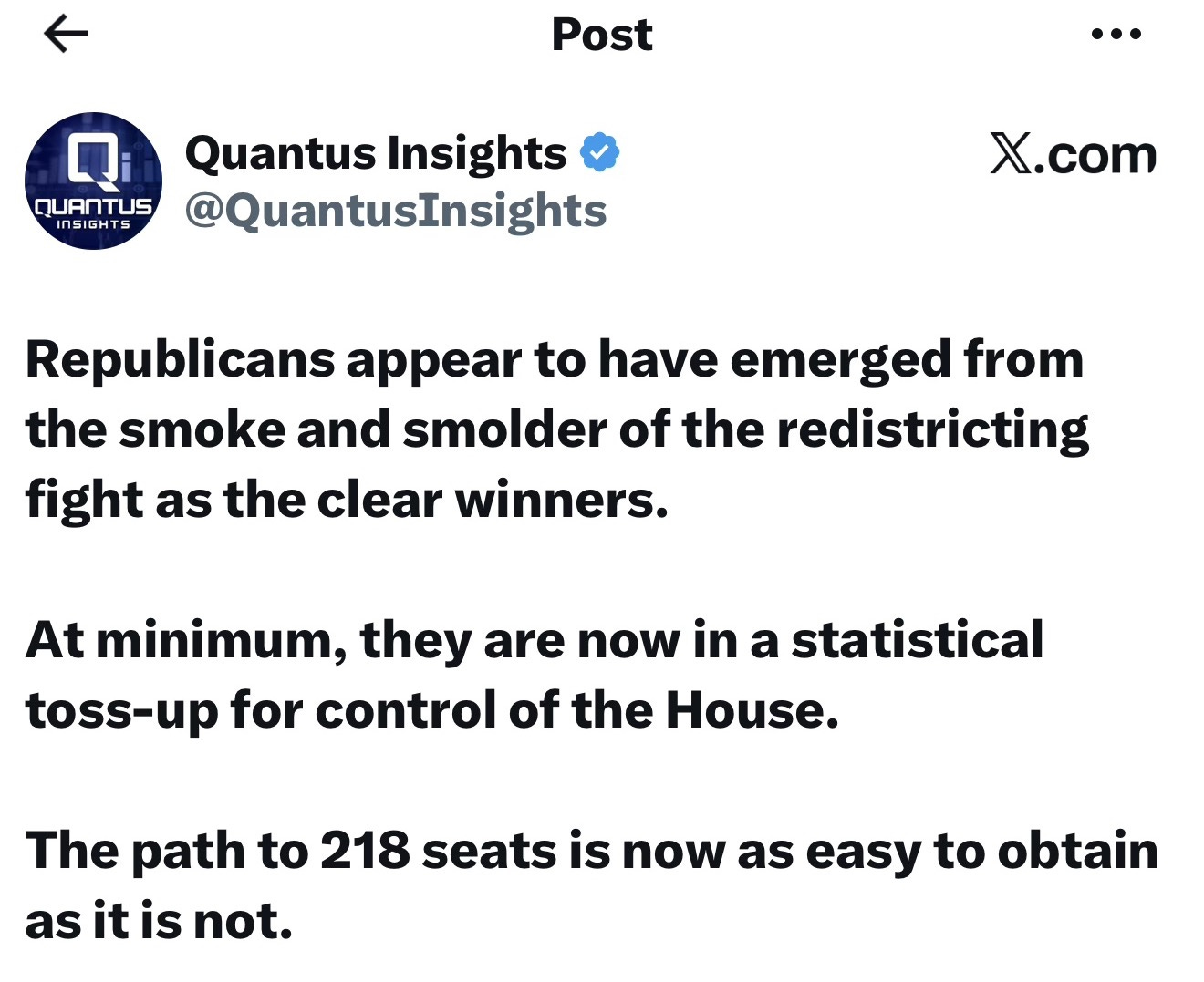
Just two weeks ago, the Democrats needed six or seven seats to flip the House.
Now after the latest redistricting moves, the Virginia ruling, and Cook’s 12 race-rating changes — 11 toward Republicans — the practical target now looks closer to 12 to 14 seats.
And that is where the pundits caught up to Zoose.
And that brings us to the second part of the 2026 picture: the Senate.
A Cheap Senate Disaster Menu: Two Buck Chuck and Lo Maine
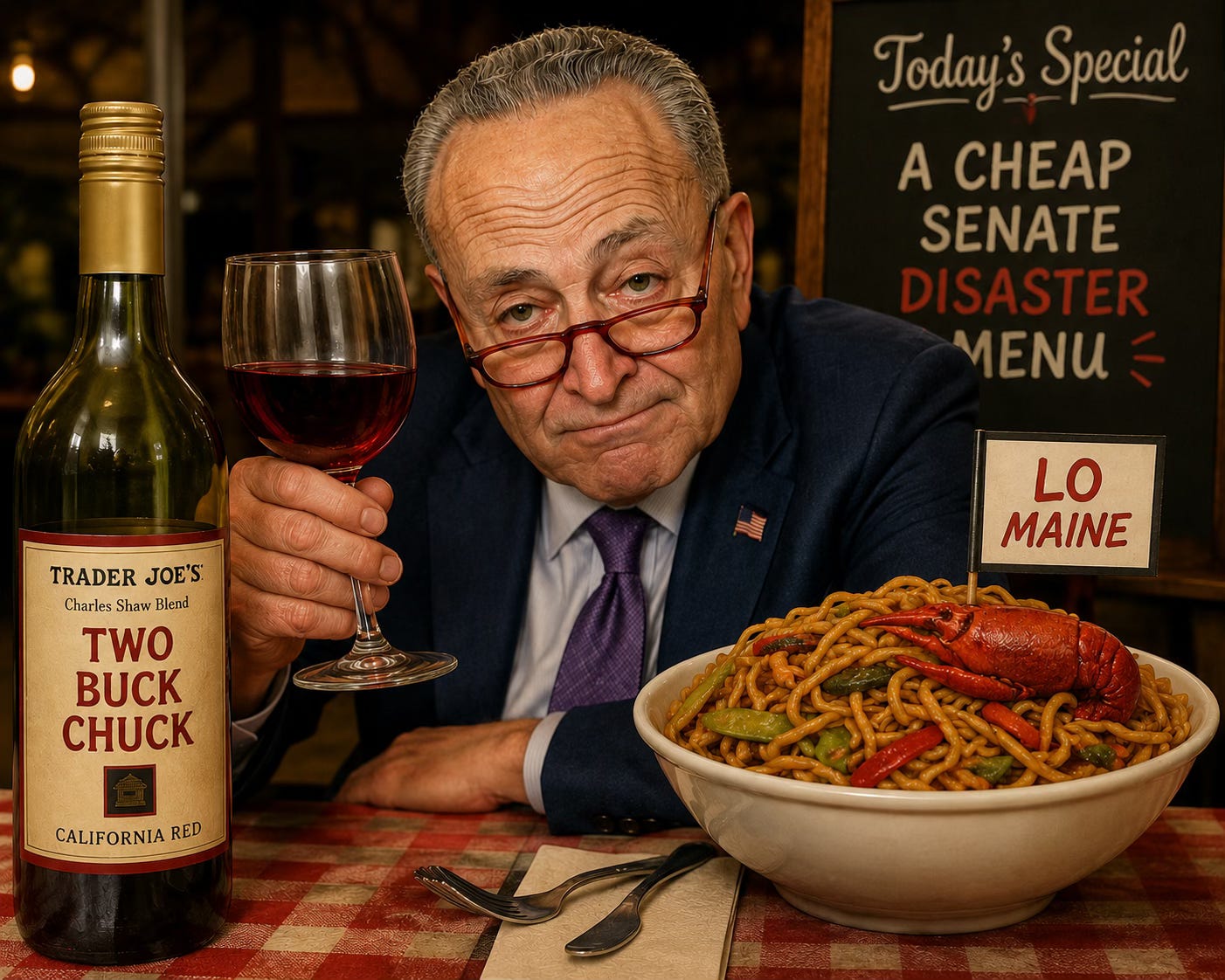
Two weeks ago, Zoose told readers that Janet Mills’s position in the Maine Senate race was becoming increasingly untenable. Schumer had promised her a path, but a promise is not a campaign.
In modern Democratic politics, establishment support only matters if it shows up when the pressure comes.
Then, Mills was out.
Her exit cleared the way for the race Zoose said was coming: Graham Platner versus Susan Collins — a progressive-versus-moderate showdown that could become one of the defining Senate races of the 2026 midterms.
But this week, the story is bigger than Mills.
It is the Senate map.
Democrats need a net gain of four seats to take control. That means they cannot simply have a good night. They need a near-perfect path.
Cook has moved some Senate races in Democrats’ direction. Georgia and North Carolina look better for Democrats. Ohio is more competitive. Texas and Alaska are still being watched.
But Maine is the hinge.
Without Maine, the Democratic path starts to narrow fast.
Platner may excite the progressive base. He may dominate online. His insurgent energy may look powerful in a primary. But Maine is not a TikTok election. It is a general-election state with moderates, independents, ticket-splitters, and voters who still care about temperament, seniority, and local delivery.
Susan Collins now gets a cleaner contrast.
Not Collins versus Mills.
Not two familiar women with long records in Maine politics.
Now it is Collins versus Platner — a moderate Republican woman against a progressive man with baggage.
That gives Collins room to do what she has done for years: occupy the middle, point to seniority, and talk about what she has delivered for Maine as chair of the Senate Appropriations Committee.
That is why Mills dropping out did not just change the Maine race.
It may have changed the Senate math.
And Two Buck Chuck must own it.
He promised Mills real money and only delivered bargain-bin support when the progressive wing turned up the pressure.
While the nickname may be funny, the Senate math is not.
If Texas stays Republican, Alaska stays Republican, and Collins holds Maine, Democrats are left needing to hold every vulnerable Democratic seat, flip North Carolina and Ohio, and then somehow find two more pickups from much tougher terrain.
Schumer may have just surrendered the Senate in real time.
Without Maine, the Democratic Senate path goes from difficult to nearly impossible.
So Where Are We At This Week?
📊 Zoose National Mood Index (ZNMI) Week Ending 5/8/26
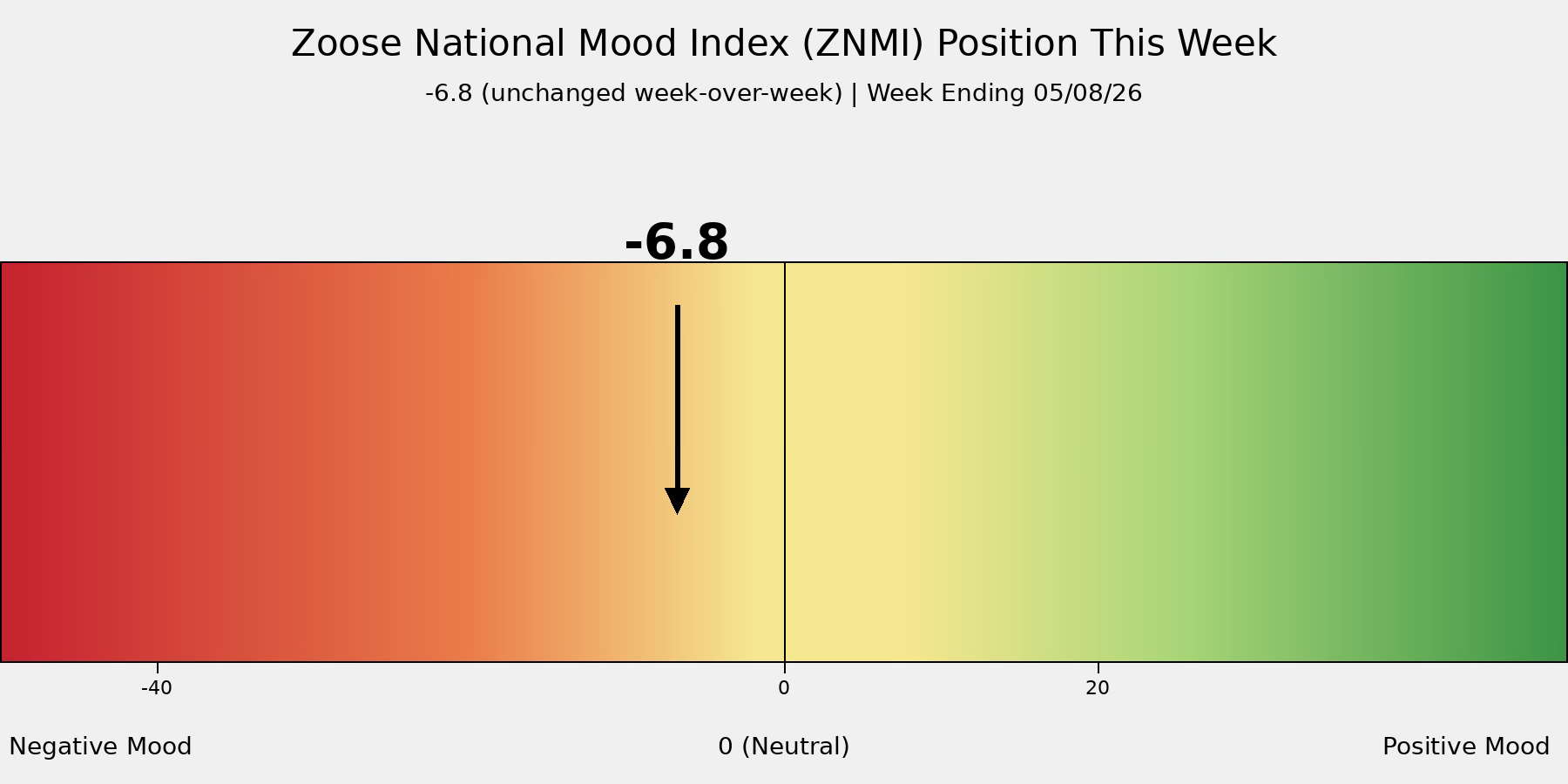
This week’s ZNMI is held at -6.8 due to limited new polling across two of the three core inputs. Presidential approval softened modestly, but without fresh generic ballot and right track/wrong track updates, we are not moving the composite on a single data stream. Weekly mood signals improved slightly on stronger labor data, reinforcing a stabilization story — with a clearer ZNMI read expected next week as more polling updates.
📡 Weekly Mood Signals — Week Ending 05/08/26
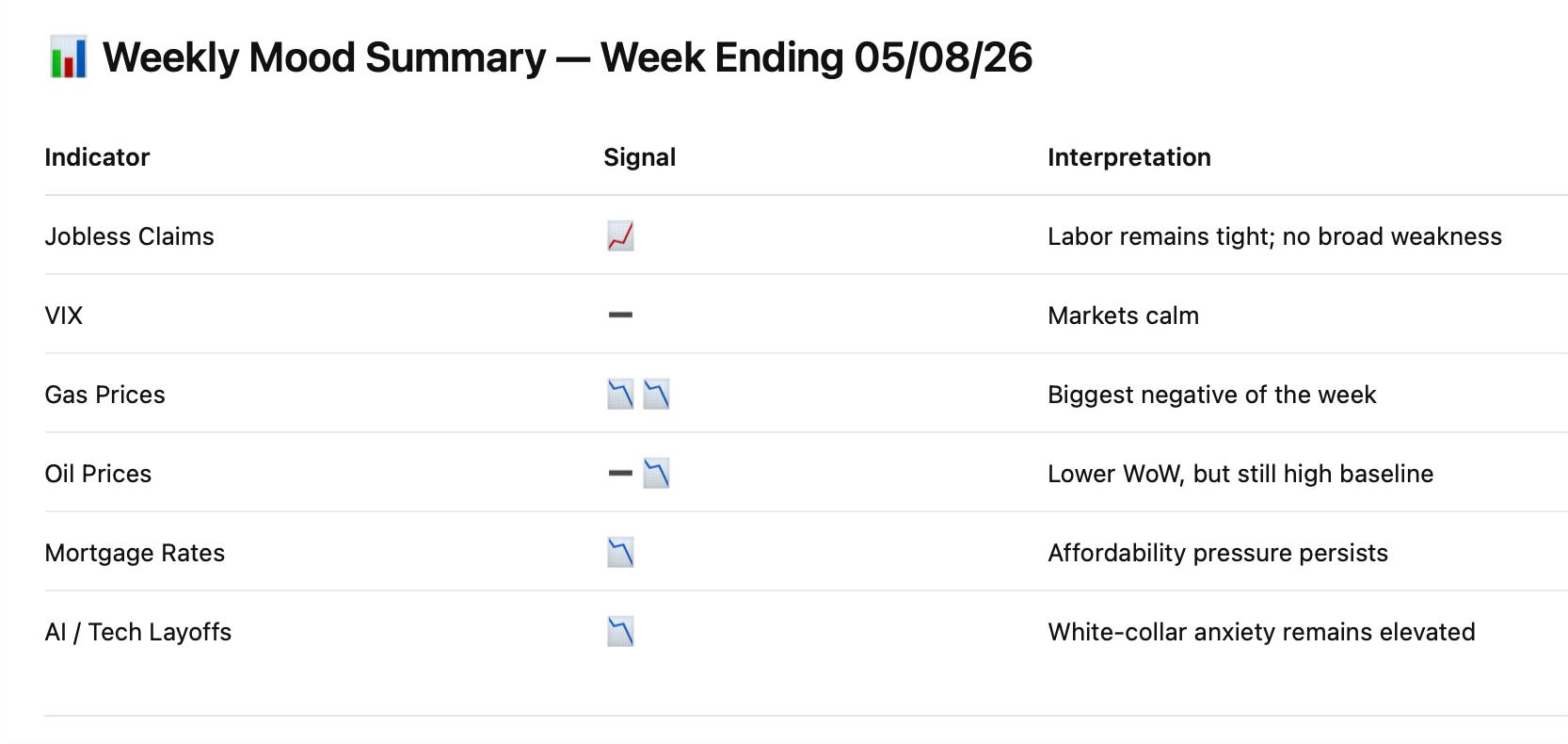
➖📈 Jobless Claims — Still Tight
Key figures (WE 5/2):
Initial claims: 200,000 (↑ 10,000)
4-week avg: 203,250 (↓ 4,500)
Continuing claims: 1.766M (↓ 10,000)
Why this matters:
A small weekly increase, but the four-week average fell and continuing claims hit a new two-year low. The labor market remains “low-hire, low-fire” and resilient.
Directional signal: 📈 (mild)
➖ VIX — Calm Band
Close (5/8): 17.19
Range stayed in the mid-to-high teens.
Why this matters:
Volatility remains restrained — markets are not pricing panic.
Directional signal: ➖
📉 Gas Prices — Pressure Back Up
National average: ~$4.55
Up ~25 cents WoW.
Why this matters:
This is the most visible cost pressure voters feel. A quarter-dollar weekly jump is meaningful and feeds inflation anxiety.
Directional signal: 📉📉
➖📉 Oil — Down on the Week, Still Elevated
WTI: ~$95.42 (weekly decline)
Brent: ~$101.29 (↓ >6% WoW)
Why this matters:
Oil cooled as diplomacy reduced immediate supply fears — but prices remain high enough to keep gas and inflation expectations elevated.
Directional signal: ➖ (slightly negative)
📉 Mortgage Rates — Drifting Higher
30-year fixed: ~6.35%–6.47%
15-year fixed: ~5.60%–5.75%
Why this matters:
Rates remain sticky at elevated levels, keeping affordability strained and limiting any “pressure relief” narrative.
Directional signal: 📉
📉 AI / Tech Layoffs — Ongoing Anxiety
Fresh layoff headlines continue across major firms, often explicitly framed as AI-led restructuring (leaner payrolls to fund AI capex).
Why this matters:
Even when the macro labor market looks fine, this keeps white-collar confidence fragile and reinforces “future job insecurity.”
Directional signal: 📉


This week on Zoose TV, we follow up on our Midterm Madness thesis: the blue-wave narrative is still missing the math in the map.
A progressive TikTok creator asked, “What the **** is happening in this country?” — and then walked through the same redistricting chaos Zoose warned about last week. A must watch on Zoose TV.
📺 This Week on Newsmax
Last Monday, I joined Finnerty, with Bill Spadea guest hosting, to break down why the “blue wave” math may not add up — and why Janet Mills dropping out dramatically improves Susan Collins’ chances in Maine.
Made the Sunday morning show, Wake Up America with hosts Bill Spadea and Sarah Williamson, alongside Trump pollster, John McLaughlin, former Congresswoman Nan Hayworth, and Doug Burns, to discuss California’s governor race.
🔥 20 Minutes a Week with ZPI = More Political Insight Than Most Insiders.
Zoose® is a multi-patented AI company founded by veteran campaign operative Patrick Allocco, creator of the Zoose Political Index (ZPI), a nonpartisan weekly model of U.S. elections and voter sentiment. Allocco appears regularly on Newsmax to break down the data for a national audience.