
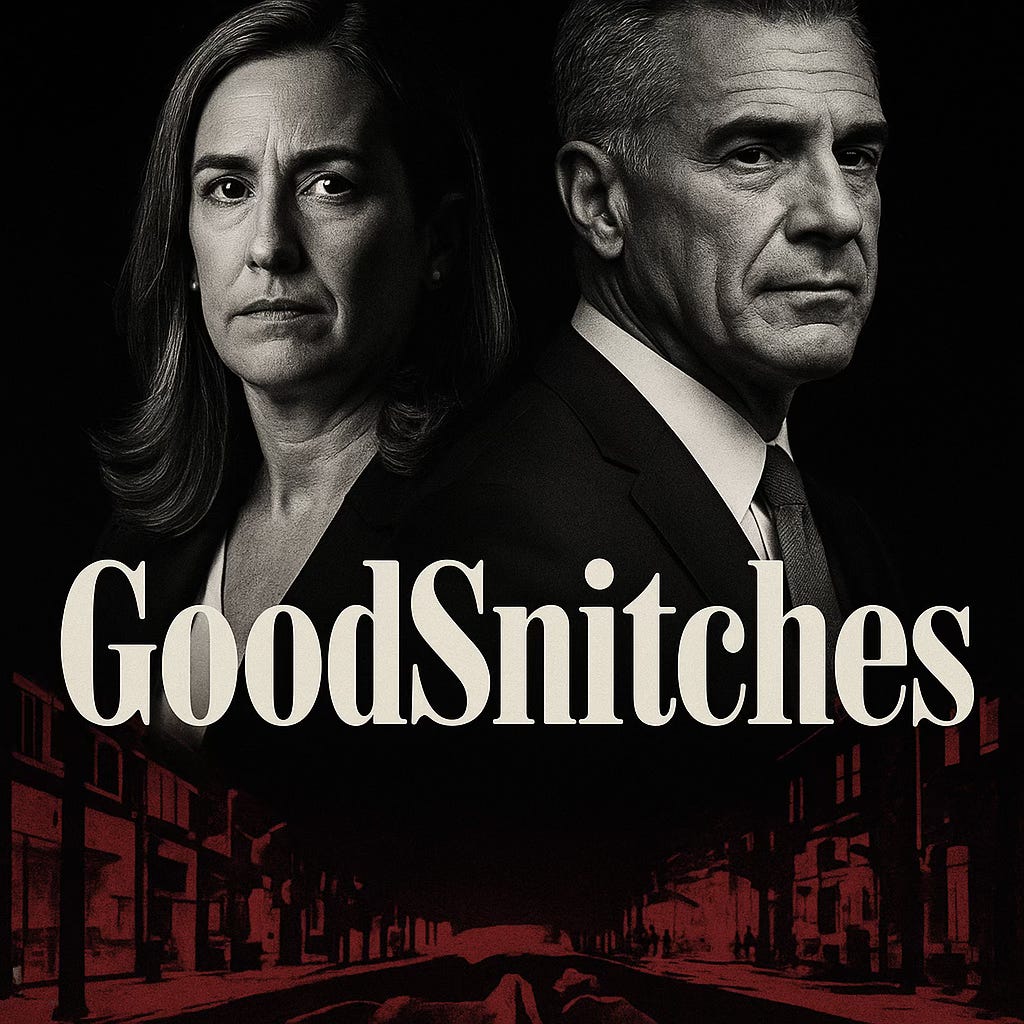
GoodSnitches
The Art Of The Political Hit.

📝 Editor’s Note
We are now 36 days from Election Day, and at this point even the most cynical reader has to admit it — Zoose called this race months ago.
The analytical record speaks for itself: we’ve consistently produced the most accurate, predictive data in the New Jersey Governor’s race.
Since January, our models have identified shifts weeks before traditional pollsters confirmed them — translating noise into narrative and narrative into probability.
Today’s analysis is not about moral judgment or partisan spin. It’s about how stories behave — how a single leak, allegation, or symbol enters the bloodstream of a campaign and reshapes the strategic terrain.
At Zoose, we treat politics as a system, not a spectacle. Our method is probabilistic, not performative; our aim is to forecast not just what happened, but what happens next.
So as we explore “GoodSnitches,” consider it a case study in narrative dynamics — an anatomy of how message, emotion, and timing converge in the equilibrium politics of 2025.
Programming Note: The Lieutenant Governor’s Debate will take place tomorrow night, Tuesday, September 30. The event will take place in front of a live audience and will be hosted by Kean University in Union, New Jersey, and air live from 7–8 p.m. ET across all PIX11 platforms. Click here to live stream.
Just four years before the scandal would unfold at Annapolis, Martin Scorsese released Goodfellas — a film that turned loyalty, silence, and betrayal into a code of its own.
Jimmy Conway’s first rule — “Never rat on your friends, and always keep your mouth shut” — wouldn’t last a day at the U.S. Naval Academy.
At Annapolis, silence isn’t rewarded — it’s punished. The Honor Concept demands candor over omertà: Midshipmen do not lie, cheat, or steal — nor tolerate those who do. Refusing to cooperate in an official investigation — even out of loyalty — isn’t valor. It’s a violation of candor.
And that’s where Mikie Sherrill’s story becomes more than a campaign footnote.
When the New Jersey Globe broke the story that Sherrill didn’t walk at her 1994 graduation because she refused to “snitch” on classmates in a cheating scandal, it initially sounded like a small signal in the noise. Within hours, it became a national sensation. First came the pickup from every outlet hungry for a headline mixing military, honor, and hypocrisy. Then came Sherrill’s carefully worded denial — that she simply “refused to snitch.”
In the background, a routine FOIA request filed months earlier by Nicholas De Gregorio — a Marine veteran and former Republican congressional candidate who sought to run against Josh Gottheimer — set the stage. Upon receipt, he voluntarily turned over the files to the Ciattarelli campaign. The request produced Sherrill’s unredacted military file; portions were inadvertently released by the National Archives just as the Globe story broke.
Within 48 hours, the controversy moved from social media to Capitol Hill. CBS News confirmed the release and reported the file — including Sherrill’s Social Security number and home address — triggered choreographed ‘outrage’ from New Jersey’s Democratic congressional delegation, which demanded a formal investigation. In a letter led by Rep. Frank Pallone, joined by Senators Booker and Kim and seven House Democrats, the delegation called the breach a “dangerous and corrupt attempt to weaponize the federal government for political purposes.”
Republicans, by contrast, treated the controversy as a process error, not a political scandal — underscoring how sharply the reactions break along party lines.
The National Archives has since admitted technician error and apologized to Sherrill. CBS reported the documents match what Sherrill herself obtained in 2017 — no new revelations, just a breach of process. Importantly, both CBS and NJ Globe clarified that the original Naval Academy story (not walking at graduation) was unrelated to the improper release.
By nightfall, competing hashtags flooded social media — some mocking, some moralizing — each convinced they’d found the wedge.
But beneath the noise, something deeper is happening. The real question isn’t whether this helps or hurts; it’s how each campaign uses it — and whether the voters who actually decide this race, our persuadable Phoenix voters (low info, low engagement), care at all.
🎭 The Politics of Outrage
Outrage is part of the playbook. Democrats are doing what seasoned campaigns do: claim the moral high ground, rally the base, and frame a line crossed. It’s not just indignation; it’s strategy.
Opposition research isn’t dirty — it’s due diligence. If Ciattarelli’s team did not investigate Sherrill’s record, that would be political malpractice. You can take it to the bank Sherrill’s team has done the same — and has shown their hand.
“10% Sales Tax Jack” didn’t happen by accident. The label dates back to 2017, when Ciattarelli floated a plan to broaden New Jersey’s sales tax base while cutting income taxes — a reform that never advanced.
Her operatives had full knowledge it had nothing to do with 2025 — but they also knew a good soundbite never dies. They dusted it off, stripped it of context, and repackaged it as a pocket-sized hit piece. Dirty trick or smart strategy? In modern politics, it’s often both.
Negative framing cuts both ways; the only question is who wields it better.
⚔️ Stone’s Rule #41: Attack, Attack, Attack — Never Defend
No one understood the art of attack better than Roger Stone — political advisor, provocateur, NY Times Bestselling author and perennial figure in the DC power elite. A man who has served, advised, or haunted the orbit of every Republican president since Nixon, Stone built his legend on loyalty.
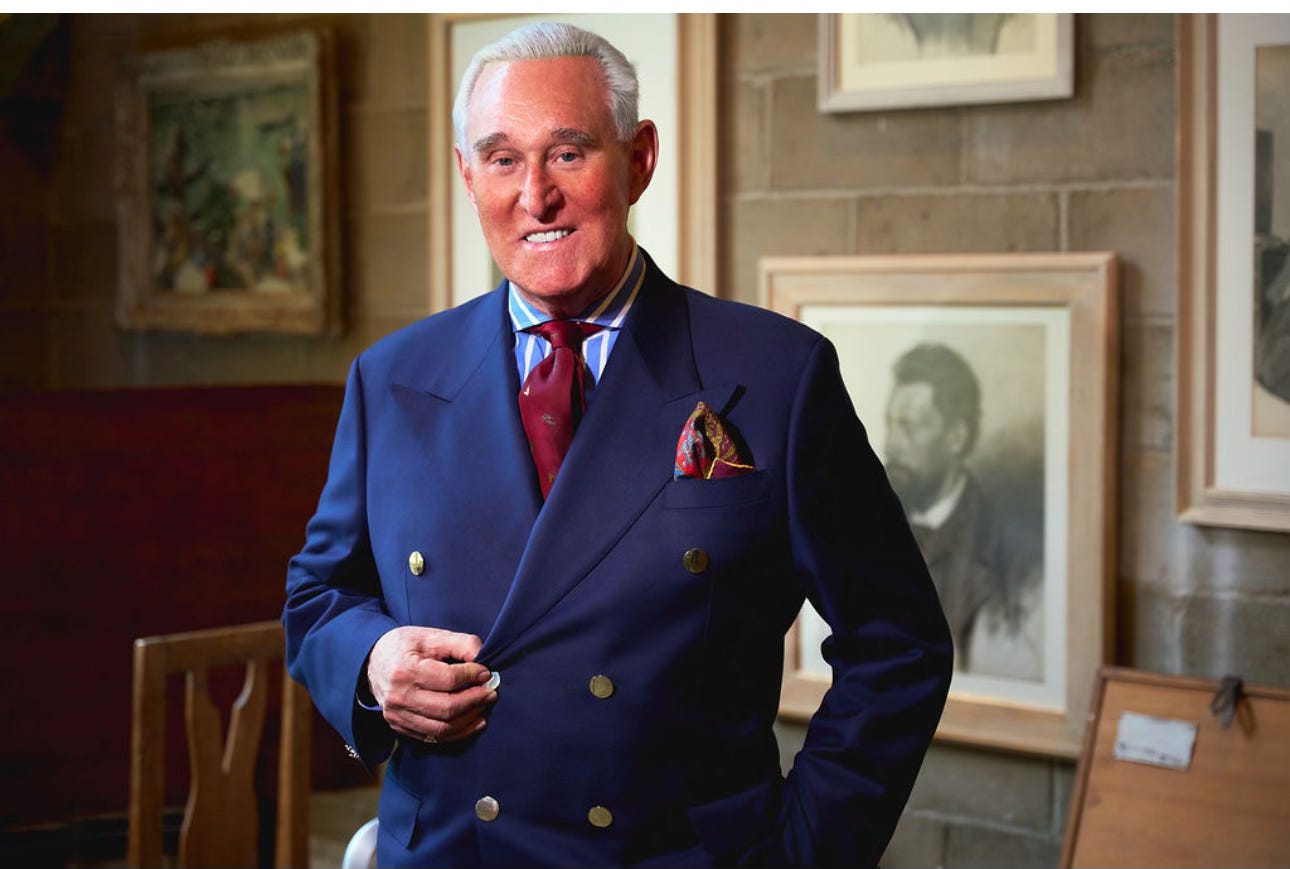
He’s gone to trial, nearly went to prison, but never turned — the anti-rat in a city full of them.
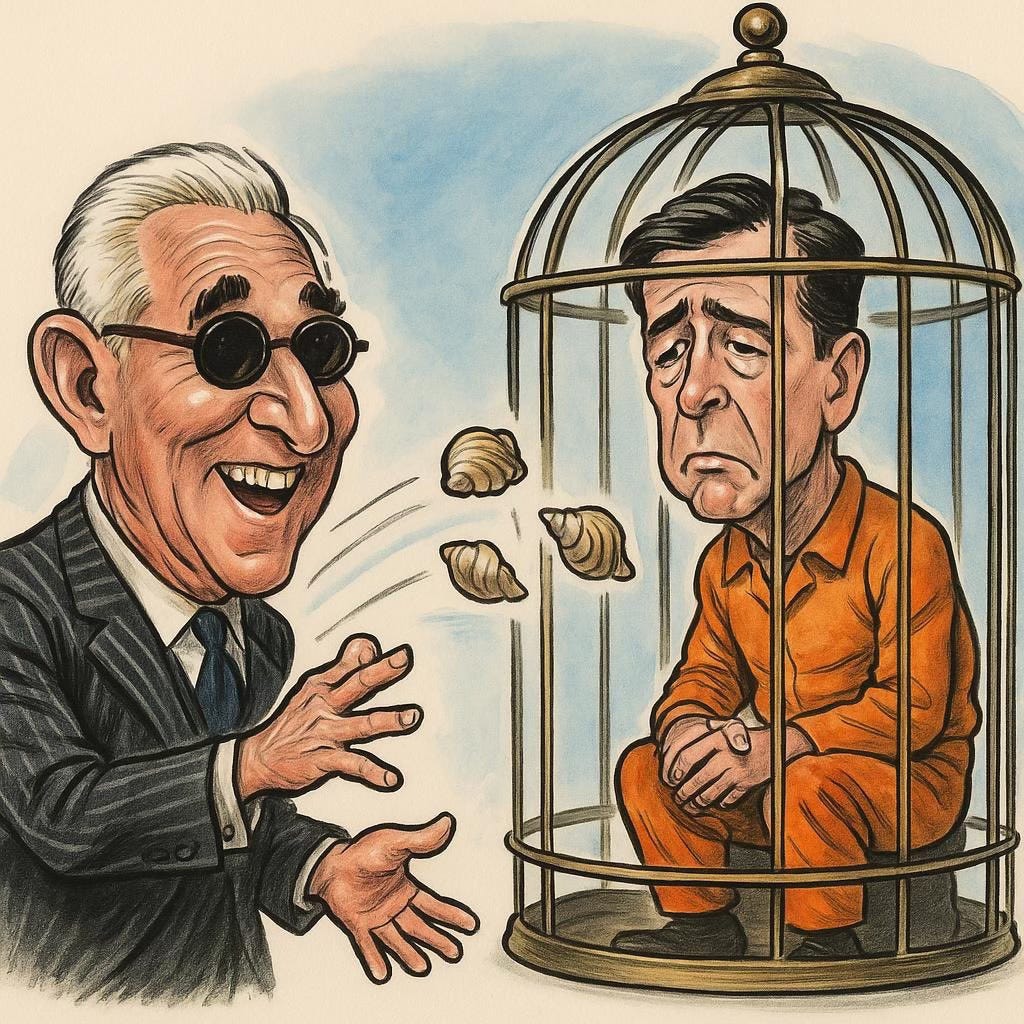
Cross him at your own peril. Just ask former FBI Director James Comey, whose high-profile pursuit of Stone and Trump has kept him in legal crosshairs — now with two indictments of his own, and a birdcage cartoon captioned “What goes around comes around. #Karma.” The twist? Comey now faces the very charge — lying to Congress — that once sent Stone to trial. In this high-stakes game, no one’s untouchable.
In his book, Stone’s Rules—How To Win At Politics, Business And Style, he quotes Nixon operative Murray Chotiner, who taught a generation how to win ugly:
If it is necessary to issue a denial of charges leveled against you, do it quickly and only do it once!
Avoid repeating the charges, anywhere, ever.
Counterattack with greater ferocity.
In other words: Attack. Attack. Attack. Never defend.
Sherrill’s team took the riskier route. By explaining — “I didn’t cheat, I just refused to snitch” — they repeated the charge. By citing “illegal leaks,” they signaled weakness. And by pairing it with a fundraising plea, they converted a liability into a transaction. That may energize the base — but it seldom persuades the middle.
⚓ The Code That Drew the Line
Unlike West Point’s strict duty to report every violation, Annapolis emphasizes personal integrity over mandatory enforcement. Refusing to voluntarily report misconduct isn’t itself an Honor Violation. Refusing to cooperate once questioned is an administrative violation of candor — a breach of duty, not a badge of loyalty. That distinction likely explains Sherrill’s graduation consequence: not breaking the Honor Concept, but defying the process that enforces it.
⚖️ The Clash of Codes
Here’s the heart of the scandal: Jimmy Conway’s loyalty code collides with the Naval Academy’s Honor Code.
One says, “Never rat on your friends.”
The other says, “Tell the full truth, even when it hurts.”
Sherrill’s stand wasn’t cinema; it was an institutional violation of candor. In politics, that contradiction becomes a weapon:
To Democrats, it’s character.
To Republicans, it’s conduct unbecoming.
🧩 The Campaign Chessboard
This is a Rorschach test; everyone sees what they want:
Republicans: Confirmation bias served hot. She broke the rules then; she bends them now. It slots neatly into a message about trust, integrity, and hypocrisy — and bolsters a broader case that she’s flouted rules before (defense stock trades while on Armed Services; net worth gains in office). Attack, attack, attack.
Democrats: Proof that GOP operatives will dredge up anything to smear a veteran, a woman, a mom. They see Trump’s fingerprints on every file. Rally, rally, rally.
Media: Irresistible morality tale. Naval Academy. Cheating. Snitch.
💰 The Fundraising Effect
In the digital era, scandal is monetizable. Within hours, Sherrill’s campaign blasted an appeal on social media.
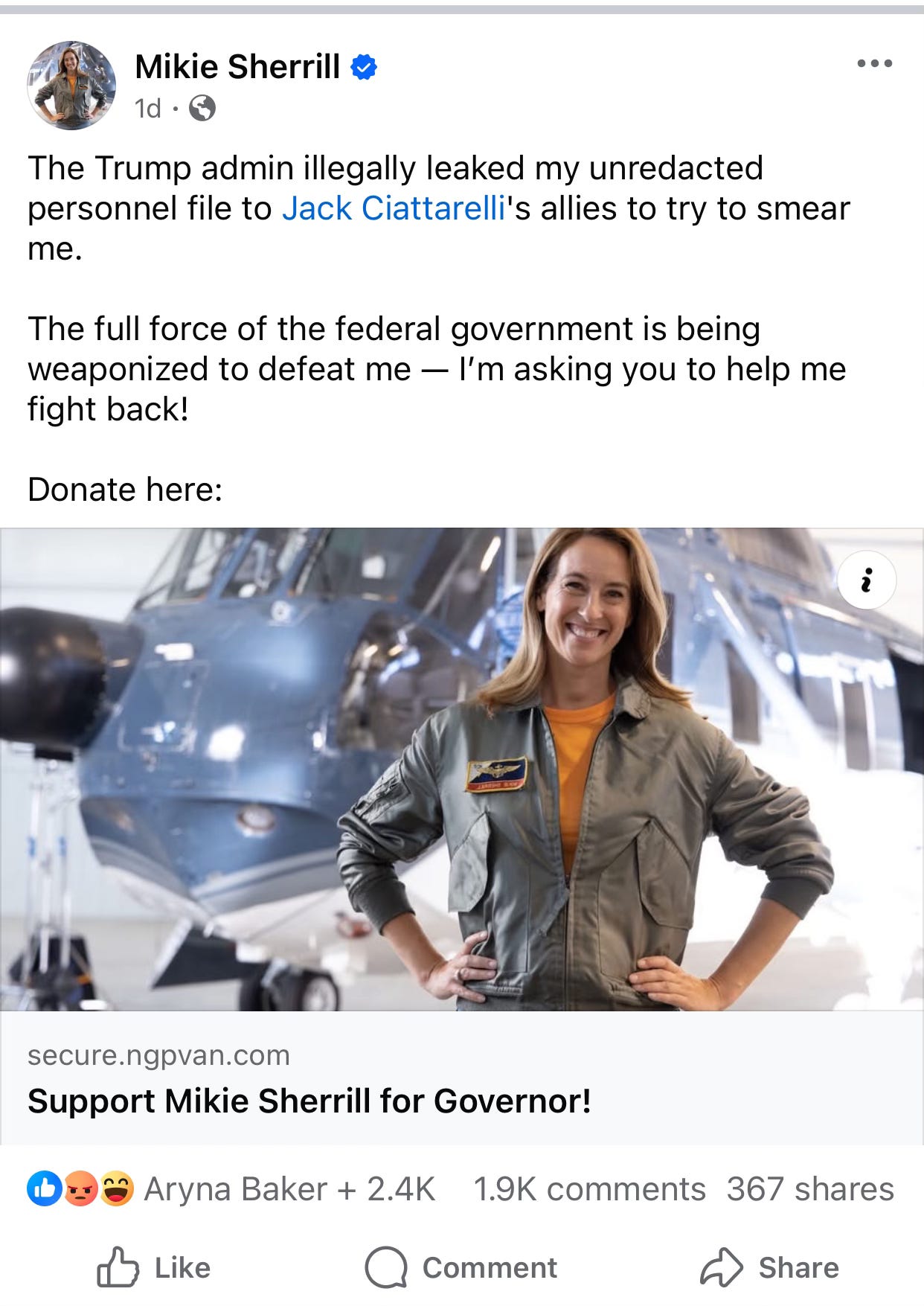
The short-term benefit: money and attention.
The long-term risk: reinforcing fatigue among disillusioned progressives who already see the Democratic establishment as cynical and self-serving.
🔥 The GOP’s Strategic Advantage
Ciattarelli’s team followed Chotiner:
No denial — the campaign didn’t file the FOIA and didn’t need to explain a bureaucratic error.
No distraction — keep the focus on Sherrill’s conduct, not paperwork.
No apology — apologizing for an opponent’s scandal is how you own it.
Just attack — and link. Within 24 hours, they threaded a simple story:
“First she violated Naval code. Then she got rich in Congress.”
They don’t need to prove it; they just need to plant the seed. Voters retain the emotional residue.
🕊️ The Phoenix Voter: Do They Care?
Phoenix voters — the 13% persuadables — don’t crave justice; they crave authenticity. They absorb headlines, not footnotes.
“Sherrill… cheating scandal… didn’t walk at graduation” → faint negative.
“Trump allies… smear… leak” → faint fatigue.
Net effect: equilibrium. Leaners harden; undecideds shrug. The scoreboard says tie — but initiative beats defense on momentum.
🧭 Strategic Takeaways
For Ciattarelli: Stay on offense. Don’t litigate details. Fold this into a broader story about trust, privilege, and “rules for thee.” Tie back to cost of living, corruption, character.
For Sherrill: Stop defending. Pivot to mission. “I served 10 years flying helicopters for my country.” Treat it as a loyalty test, not a scandal. Own the principle, then move on — fast.
For Voters: This isn’t about snitching; it’s about narrative control. The candidate who dictates the story wins.
⚖️ Who Won the Week
Net Outcome: Tactical Win → Ciattarelli | Strategic Containment → Sherrill
Ciattarelli’s Upside
Narrative control: Ethics/trust terrain. Discovering > defending.
Pattern reinforcement: Repetition makes truth — “Oops… she did it again.”
Base motivation: Red meat without blowback; oppo = competence.
Persuadables: No penalty for vetting; preparedness reads as strength.
Net Gain: Emotional activation + narrative cohesion + low blowback → +0.2 momentum (ZPI drift).
Sherrill’s Limited Win
Rally the base: Outrage = oxygen (esp. progressive women).
Sympathy shield: Archives error reframes as process breach, not corruption.
Moral high ground: “I refused to snitch” plays as principle to values voters.
Net Effect: Base reassurance, little expansion.
Phoenix Factor
They file it under “D.C./Trenton nonsense” and move on. The tie holds; momentum edges rightward because initiative beats defense.
Final Read: Momentum → Ciattarelli. Money → Sherrill.
In the Honor Code scandal, the aggressor earns the edge — the accused banks the check.
🧭 Poll Convergence: When AI, National Research, and Emerson All Agree
Three lenses — Zoose, National Research, and Emerson — now converge on a dead heat and an electorate split by age, trust, and the price of power.
The new Emerson College/Pix11/The Hill poll (Sept. 22–23), the first independent survey after the debate — and the second poll since 2024 not showing Sherrill ahead — has the race tied 43–43, with 11% undecided. It mirrors National Research’s findings and confirms what the Zoose AI model flagged weeks ago: equilibrium.
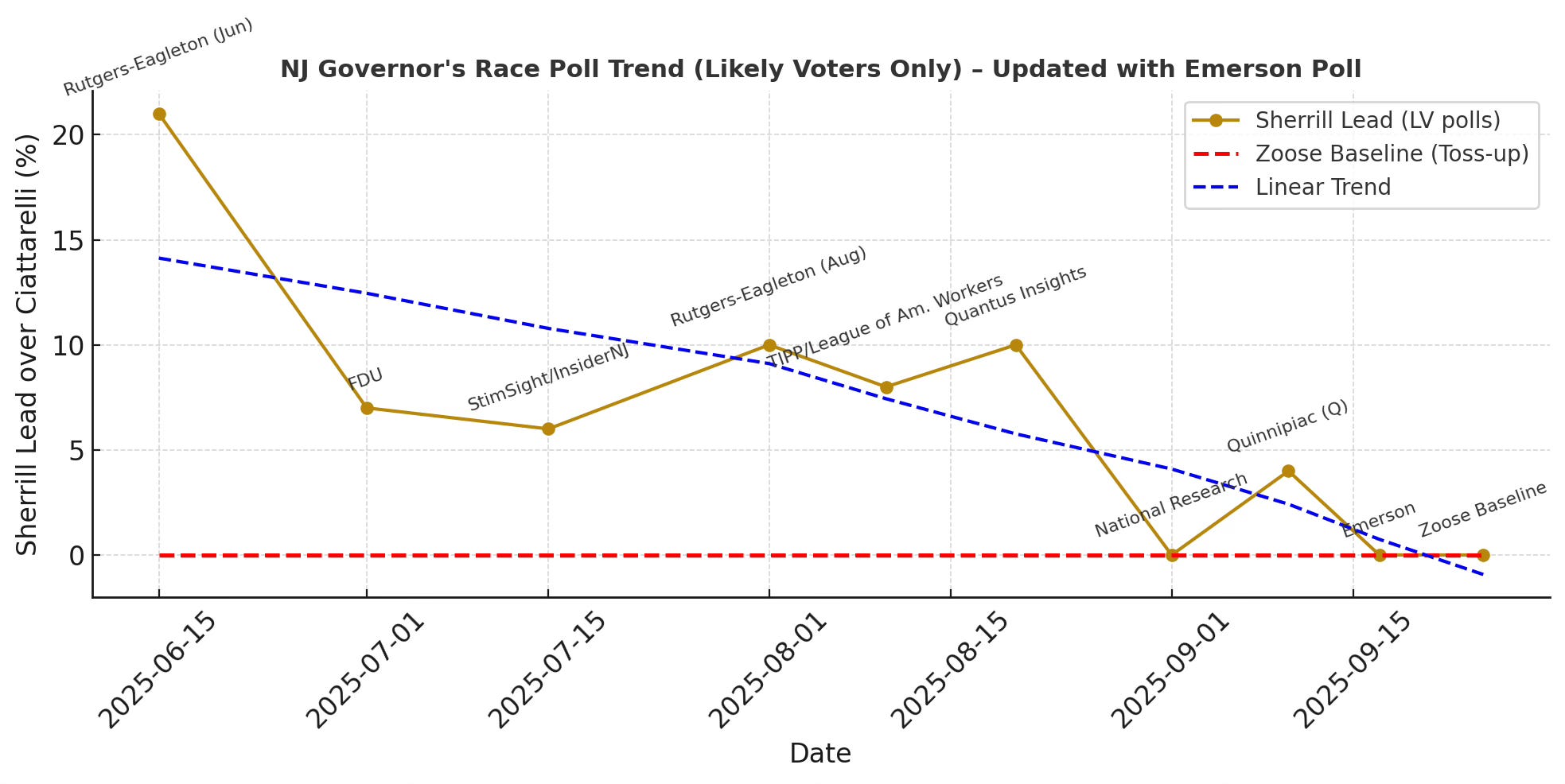
When the AI forecaster, the Republican pollster, and the independent pollster converge, it’s no longer noise—it’s signal.
👥 The Age Divide
Under 40: Sherrill 58–24
40s: Sherrill 47–40
50+: Ciattarelli 52–36
It’s the age inversion Zoose has tracked all summer: Sherrill’s coalition (youth and women 21–44) vs. Ciattarelli’s resurgence (men 45+ and values voters). Younger voters are her firewall; older voters are his foundation. In between lies the Phoenix corridor — the 13% holding the balance. This isn’t persuasion; it’s polarization by cohort.
The 2025 race isn’t red vs. blue — it’s young vs. old, renter vs. retiree, future vs. frustration.
⚡ The Price of Power
Who’s responsible for rising utility costs?
30% utilities • 22% Gov. Murphy • 7% federal • 4% grid • 35% “all of the above.”
Parties split on blame, not pain: Democrats → 36% utilities; Republicans → 36% Murphy; Independents split (27% governor / 23% utilities). Energy affordability is the universal wedge: whoever owns the fix, owns the future.

🧠 Zoose Synthesis
Convergence marks a new phase:
Momentum: Ciattarelli
Math: Sherrill (registration edge)
Margin: Persuadables
New Jersey’s 2025 race is no longer a lead to defend, but a tie to break. In equilibrium, every headline, surge, and stumble matters.
Week 35 Rankings
But You’ve Known This All Summer.
Now You’re Friends Are Catching Up With You.
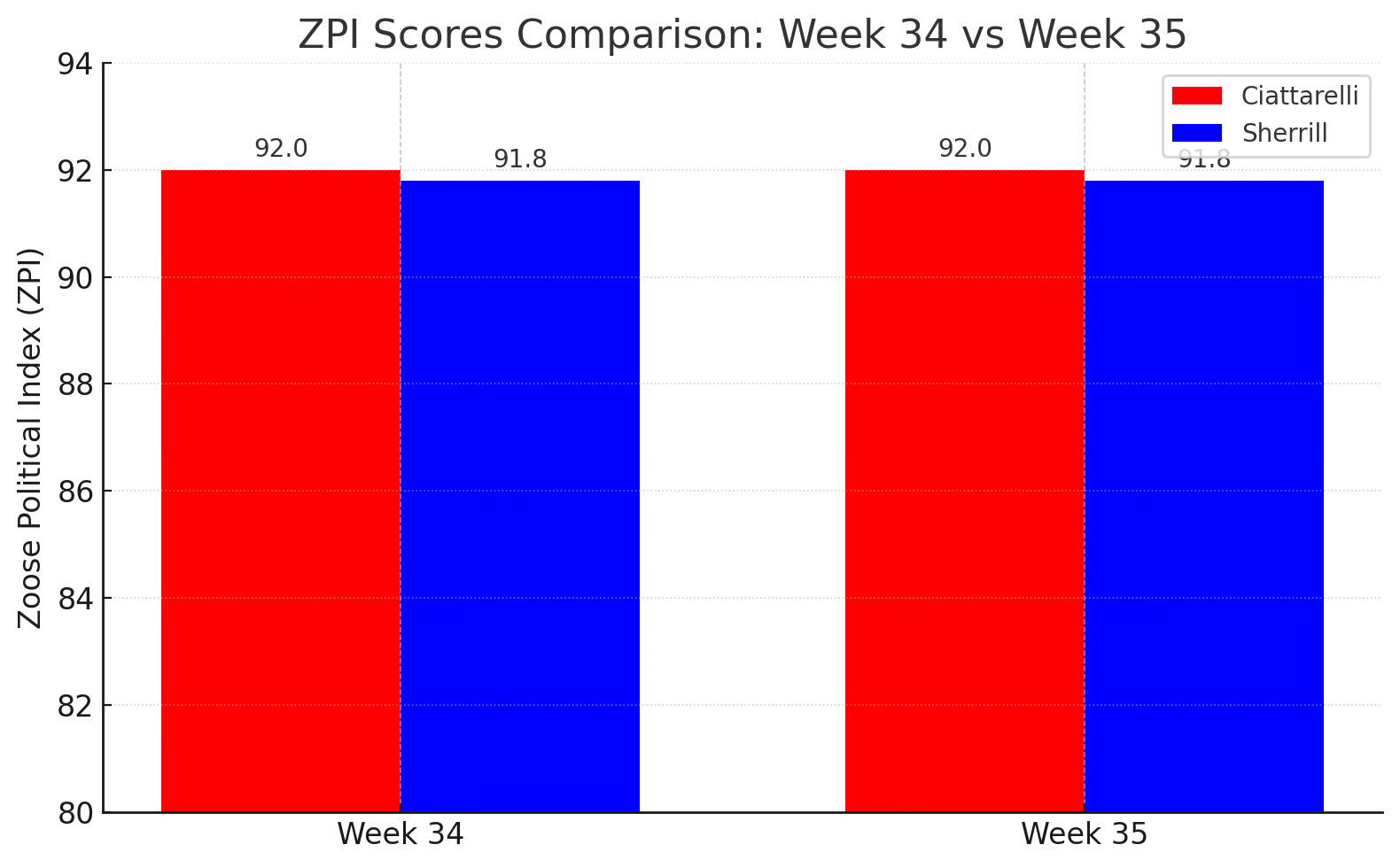
🐘 Jack Ciattarelli 🚫 0.0% 📍 ZPI Score: 92.0
🐴 Mikie Sherrill 🚫 0.0% 📍 ZPI Score: 91.8
➡️ Equilibrium holds.
Zoose (AI), National Research (partisan), and Emerson (public) all land around 43–43. We hold the line until one of two things breaks:
Phoenix women (21–44) shift, or
Turnout ops start converting energy into banked ballots.
Until then, it’s not a lead — it’s a lock.
Trendline Takeaway
Sherrill’s lead evaporated: +21 in June → 0 today
Ciattarelli consolidating +16 among 50+
Sherrill’s under-40 firewall is real — but turnout is soft
This is now a game of inches, not ideology.
ZPI Outlook
Both bases near max. The final five weeks hinge on who moves the middle — and who makes fewer mistakes.
Status: Toss-up (Frozen)
Next Trigger: Phoenix movement or an unexpected early-vote surge.
⚙️ ZPI Momentum Meter
📅 Sept 29, 2025 • 🎯 Scoreboard: Tie | Trajectory: Rightward Tilt
Segment Snapshot
Phoenix Women (21–44): ↔️ Aligned, not mobilized (Sherrill turnout risk).
Older Men (50+): 🔺 Ciattarelli gaining — trust & cost-of-living frames landing.
Independents: 😐 Split fatigue — leaning Ciattarelli on character, waiting for closure.
Partisans: 🧱 Walls up; persuasion window narrowing.
ZPI Readout
Net Shift: +0.2 → Ciattarelli (underlying drift right despite 43–43 topline)
Energy Differential: GOP enthusiasm +2 vs. Dem fundraising +1 → net +1 Ciattarelli
Signal Strength: 📶 High Confidence — Convergence + Drift Right
Momentum is emotional math — Ciattarelli’s solving for gain while Sherrill’s solving for turnout.
🎓 Education Poll Watch: The Outlier with a Lesson
Amid convergence, one issue-sponsored survey breaks from the pack. Yes. Every Kid. shows Sherrill 48–41(Independents 39–39), Sept. 20–22, n=704 LV (±3.7%). As a single-issue poll from an education-choice advocacy group, its topline likely reflects message alignment more than ballot strength — but the issue signal is real.
Voters across party lines support refundable education tax credits and expanded school choice.
For Sherrill: frame “education freedom” as parental flexibility within public education.
For Ciattarelli: expand the charter/choice plank to meet 50%+ support.
Zoose holds steady at Ciattarelli 92.0 / Sherrill 91.8 (Toss-Up) — and flags education freedom as a cross-partisan wedge to watch.
🔥 8 Minutes a Week with ZPI = More Political Insight Than Most Insiders.
🔹 About Zoose® and Patrick Allocco
Zoose® is an award-winning technology company founded by Patrick Allocco, a veteran campaign operative and former Congressional candidate. Built on multi-patented AI and human-to-human communication tools, Zoose solves real-time challenges across industries—from global support services to political intelligence.
At the forefront of its civic innovation is the Zoose Political Index (ZPI)—a nonpartisan, AI-powered election analysis platform that delivers weekly rankings, turnout modeling, and data-driven insights. ZPI has become a trusted source for understanding the evolving dynamics of the 2025 New Jersey governor’s race and soon beyond.
Patrick Allocco has advised and worked on campaigns at every level—State Senate, Congress, U.S. Senate, gubernatorial, and Presidential—giving him a uniquely practical perspective on voter behavior and strategic messaging. His experience in field operations and coalition-building fuels Zoose’s mission to cut through the noise with clarity, accuracy, and impact.
In 2024, Allocco was recognized in Who’s Who in America for U.S. Technology for his contributions to innovation and AI driven solutions.