
🎲 Time to Place Your Bets
One Week, Two Candidates, Too Close to Call


It’s the final turn before Election Day.
Two candidates. Two very different coalitions. And a race so close that every decimal of turnout could flip the outcome.
The New Jersey governor’s race began as a midyear curiosity — now it’s the national test case for persuasion, fatigue, and turnout.
So before you ask, “Who’s going to win?” — remember: this is Jersey.
No one calls this state early.
Because at this point, that’s what this election is — a bet on who shows up.
💸 Place Your Bets.
Before the pundits place their bets, the gamblers already have.
On Polymarket, the online prediction exchange where traders wager real money on political outcomes, more than $2.8 million has already been bet on the New Jersey governor’s race.
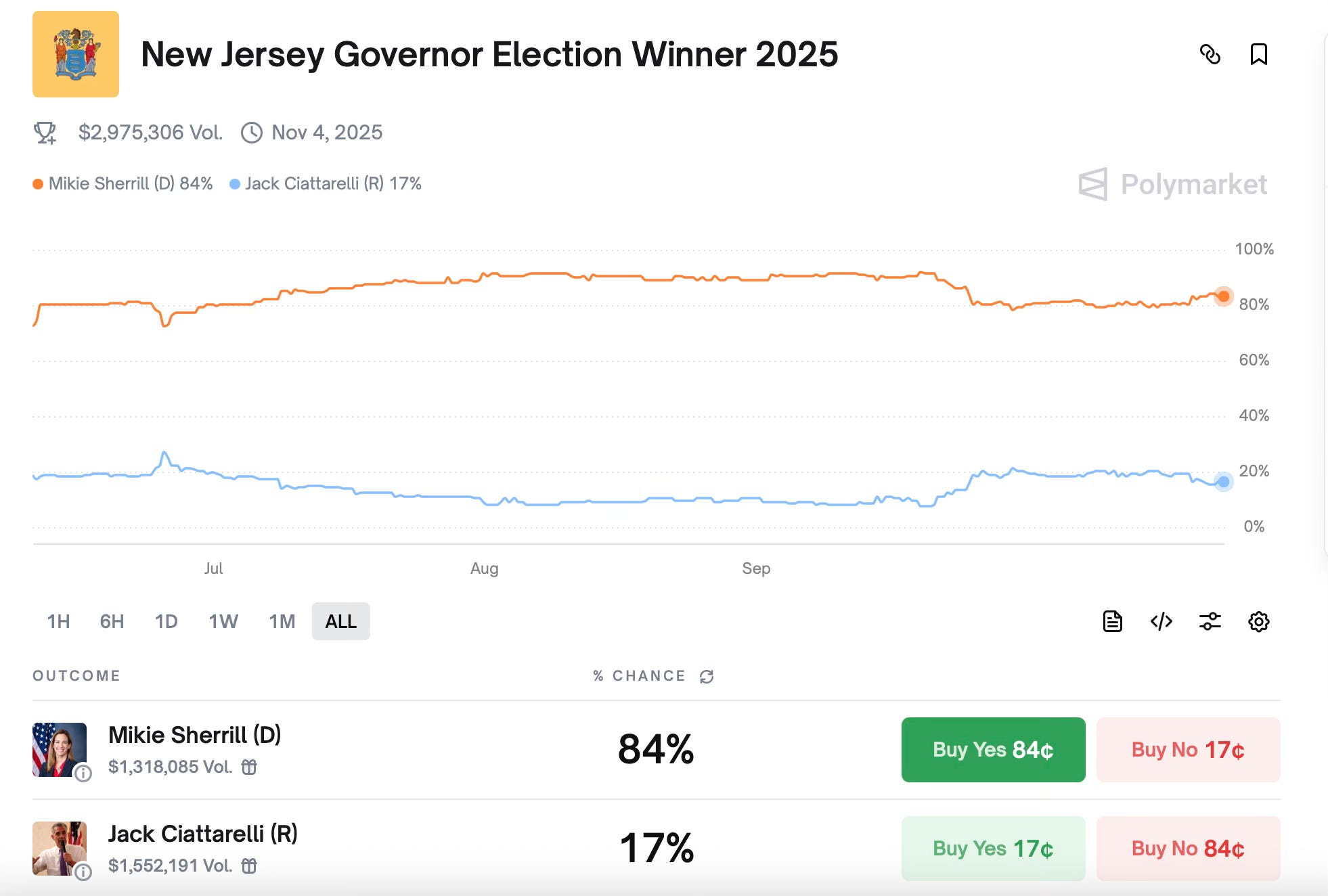
At the moment, the betting market gives Mikie Sherrill an 84% chance of winning — trading at 84¢ a share — while Jack Ciattarelli sits at 17%, trading at 17¢.
But here’s what’s fascinating:
Despite Sherrill’s higher odds, more money is actually being wagered on Ciattarelli ($1.55M) than on Sherrill ($1.32M) — the classic underdog dynamic. Gamblers are buying the long shot, not the favorite.
In betting terms, a “Yes” share pays $1 if the outcome hits. So a Ciattarelli trader buying at 17¢ would win nearly 6x their stake if he pulls off an upset.
That explains the energy. In politics as in poker, everyone loves a comeback story — and a payout.
Still, as we said on Finnerty last week, Polymarket is a lagging indicator.
It doesn’t filter out or reweight the outliers — it follows them.
The market doesn’t predict the shift; it reacts to it.
It almost always catches up to polling, turnout data, and persuasion signals only in the final 72 hours before Election Day.
For now, the odds reflect sentiment, not certainty — and sentiment moves slower than data-driven strategy.
🎯 The Pollsters Have Already Wagered
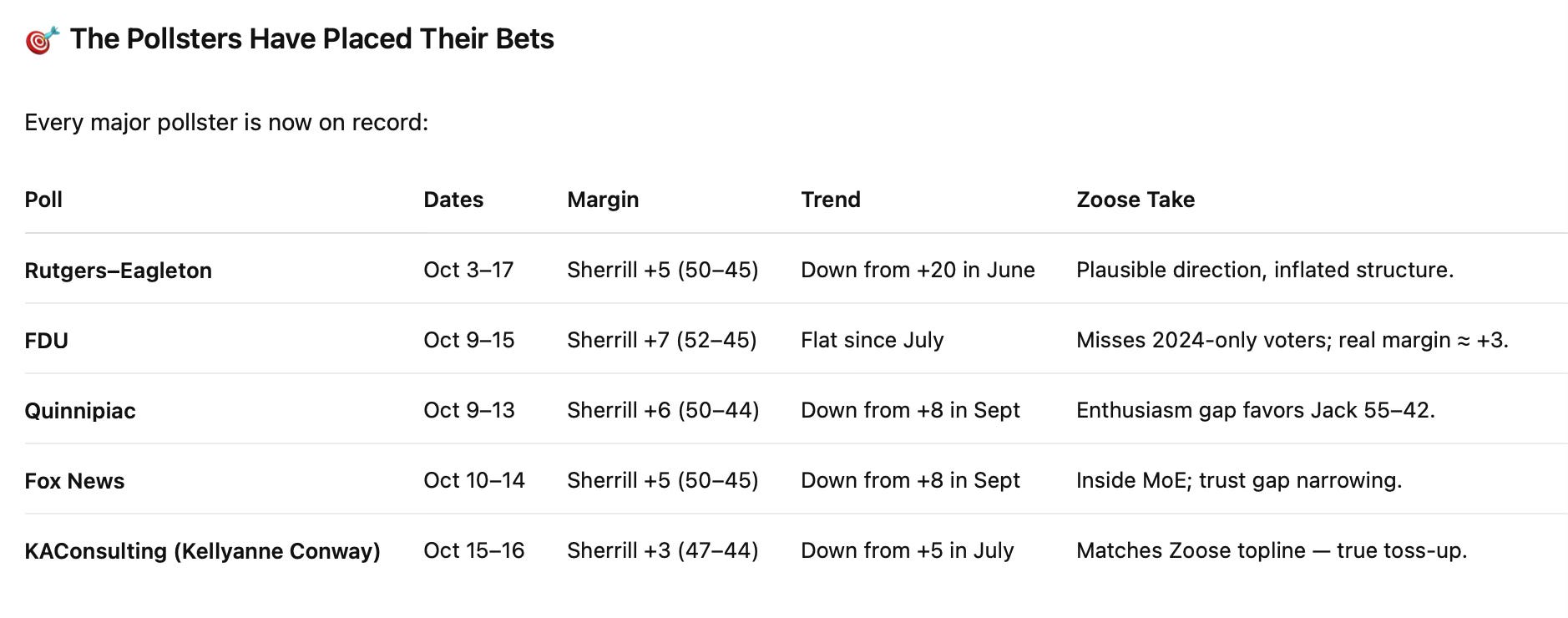
The so-called consensus is really convergence by design. Most polls still model the 2021 electorate — landlines, fixed likely-voter screens, and oversampled high-propensity Democrats. In today’s New Jersey, that’s yesterday’s voter file.
🧩 Eagleton Redux — Wildstein Gets It.
It’s been a long time since anyone besides Zoose called out a New Jersey poll in real time. But this week, we’re not alone.
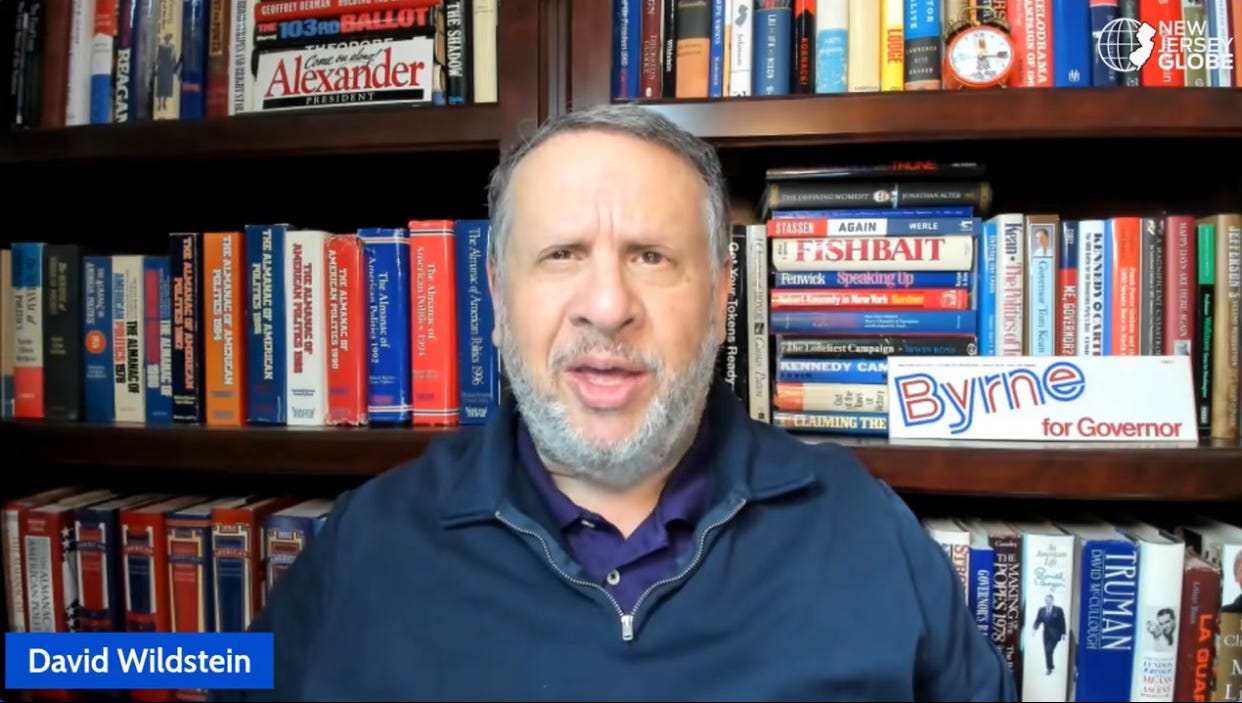
David Wildstein, Editor of the New Jersey Globe and the dean of Jersey political junkies, went live Thursday to air his grievances with Rutgers-Eagleton’s latest survey — and while his tone was characteristically diplomatic, his critique cut deep.
He flagged four fatal flaws that should make any serious poll watcher flinch:
1️⃣ Stale data. Eagleton went into the field October 3 and wrapped October 17 — before nearly $10 million in new ads, mail, and ground operations hit voters. Polls are supposed to be snapshots in time; this one’s a time-lapse.
2️⃣ Lagged release. The poll didn’t even drop until four days later — meaning it hit the wires 19 days after the first interviews. As Wildstein said, most credible pollsters release within 24 hours; this one gathered dust.
3️⃣ Skewed electorate → collapsing math. Eagleton’s sample has 32% Republicans, 21% Democrats—in a state with ~800k more registered Democrats. That weighting undercounts Democrats and overcounts Republicans—yet Sherrill is still +5. Normalize the partisan mix toward reality and her margin would grow, not shrink. Either the weighting is off, or the topline is.
4️⃣ Cross-tabs that don’t reconcile. Even within Eagleton’s own frame, Sherrill +21 among women and +9 among independents shouldn’t back into just +5 overall unless other segments are implausibly lopsided. Taken together, the partisan weighting and group margins can’t be true at the same time—that’s not a snapshot, that’s a spreadsheet error.
Wildstein put it bluntly:
“Maybe the poll is exactly right — but for the wrong reasons.”
He didn’t stop there. He reminded listeners that bad polls have consequences — they shape media narratives, fundraising, and even field operations. As he noted, “they affect strategic decisions… even field staff’s decision about whether they’re going to go out to brunch on the Sunday before the election.”
That’s the real point: flawed methodology doesn’t just distort analysis — it distorts campaigns.
We’ve been saying that since July. When Eagleton first dropped their +21 Sherrill outlier, Zoose called it “absurd.” We wrote then — and still believe — that Eagleton’s likely-voter screens miss the modern electorate: under-30 men, Phoenix women, low-propensity independents, and post-2024 reactivations.
So no, this isn’t gloating. It’s validation — and a reminder that New Jersey’s race is being shaped by behavior, not outdated turnout models.
If Eagleton’s sample were truly right — 12% fewer Democrats than 2021 but a surge of 25% 18- to 34-year-olds — the math collapses under its own weight. Those trends move in opposite directions: a smaller Democratic share would sink Sherrill, while a youth-heavy electorate would normally boost her. You can’t have both and still end up at +5.
But the data’s too bent to prove that.
🗳️ Betting the Early Vote
As of deadline, 439,554 Vote-By-Mail ballots have been returned — and Democrats still hold a large +182,000 raw edge (276,577 to 94,509).
But dig into the return rates — the share of voters from each party who’ve already mailed their ballots — and the story flips:
Republicans 51.6% · Democrats 52.1% · Unaffiliated 31.7%.
That’s effectively parity — and that’s new terrain in New Jersey. Four years ago, Republicans were trailing Democrats in this category by 8 to 10 points at the same stage. Now they’re matching them nearly ballot for ballot.
Republicans are now competing in a lane they used to concede, while Democrats are still harvesting ballots from their safest turf instead of expanding the map.
Update (Sunday PM): Day-one in-person early-vote totals show Democrats leading 38,060 to 35,533 — a 2.8% edge statewide, slightly stronger than their 2024 Day 1 performance. It’s a solid opening for Sherrill, but still within striking distance for Ciattarelli. The week’s trajectory will determine whether that early edge hardens into momentum or merely front-loads safe votes.
VBM isn’t victory — it’s field position.
Democrats are sitting on their stack. Republicans are still pressing the bet.
The map favors Mikie. The momentum favors Jack.
But the math remains stubborn.
🎯 Counting the Bets
As our friend Micah Rasmussen notes, Democrats still begin the home stretch with an enormous banked-ballot advantage — the kind of head start that forces Republicans to play catch-up across every voting method.
Micah isn’t just one of the sharpest political minds in the state — he’s a trusted voice on radio and TV, a veteran of both gubernatorial debate panels, and a perennial translator of Jersey’s political chaos into clear, grounded insight.

He’s been tracking this race with the precision of a pollster and the instincts of a campaign vet — so when it comes to reading the early-vote tea leaves, we’re not rolling the dice; we’re calling the house.
Here’s Micah’s take on how the numbers stack up eight days out — and what the early-vote math really says about each campaign’s odds.
Rasmussen writes:
In this election, I’m thinking a lot about voting method. We know Democrats will perform strongly in the vote-by-mail, as they always do. In fact, both parties are returning VBMs at a higher rate than in 2021, by about 10 percent each. But that doesn’t help the Republicans make any headway in cutting into the Democrats’ advantage, which is currently 182,068 returned ballots more than Republicans. In fact, the Democrats’ current statewide lead is 25,000 wider than it was at this same point in 2021. In that race, Democrats finished with 250,000 more VBMs than Republicans, and since the additional lead has been pretty constant over this cycle, I am estimating that Democrats will wind up 275,000 votes ahead of Republicans in VBM voting.
This makes the in-person early vote that much more important for Republicans. Let’s face it — Republicans like to vote on machines, and they’ve warmed to this mode of voting much more readily than voting by mail. Still, they’ve never managed to outvote Democrats statewide in our limited history with in-person early voting, including last year’s presidential race. They came close — 400,792 statewide in-person early votes versus 418,544 for the Democrats. But remember, an even result means Republicans go into Election Day with a 275,000-vote hole. That’s why we are watching the in-person early vote so closely, and on day one, it was more of the same — both parties turned out strongly — but Republicans could not get any traction on Democrats. In fact, 38,039 Democrats voted on the first day versus 35,512 Republicans.
This was only the first of nine days of in-person early voting. We have a political eternity left to go. But Republicans need to make up the ground somewhere. Four years ago, they did carry the Election Day vote, but by less than 1,000 votes.
Now, astute observers will point out that this means unaffiliated voters broke with Ciattarelli last time, or there were massive Democratic defections. We’re not seeing a lot of evidence for either possibility this time. The polling tells us that both candidates have consolidated their parties behind them about evenly. And it also suggests a potentially more even split among unaffiliated voters.
Zoose’s Take: Even with a stronger Republican showing, the math is stubborn. Democrats are still starting with what Micah estimates as a 275,000-vote cushion — the electoral equivalent of spotting your opponent two touchdowns before kickoff.
For Ciattarelli, the playbook is clear: dominate in-person early voting, then surge on Election Day. For Sherrill, it’s about protecting that cushion and converting high-propensity Democrats into banked votes before enthusiasm, weather, or fatigue set in.
Our Zoose model lands slightly differently on the board. Micah sees the VBM gap holding steady; we see it narrowing as Republican ballot-chasing accelerates midweek. His approach is arithmetic — turnout share by voting method. Ours is behavioral — digital activity, persuasion signals, and lagging intent data that often precede turnout by three to five days.
In other words, the bets are placed, the dice are rolling, and both campaigns are counting chips from different corners of the same table — one playing the odds, the other playing momentum.
💰 Late Breaking: The Vaad Places Its Bet
Late Saturday, the Lakewood Vaad, one of New Jersey’s most influential organized voting blocs, formally placed its bet on Jack Ciattarelli for governor.
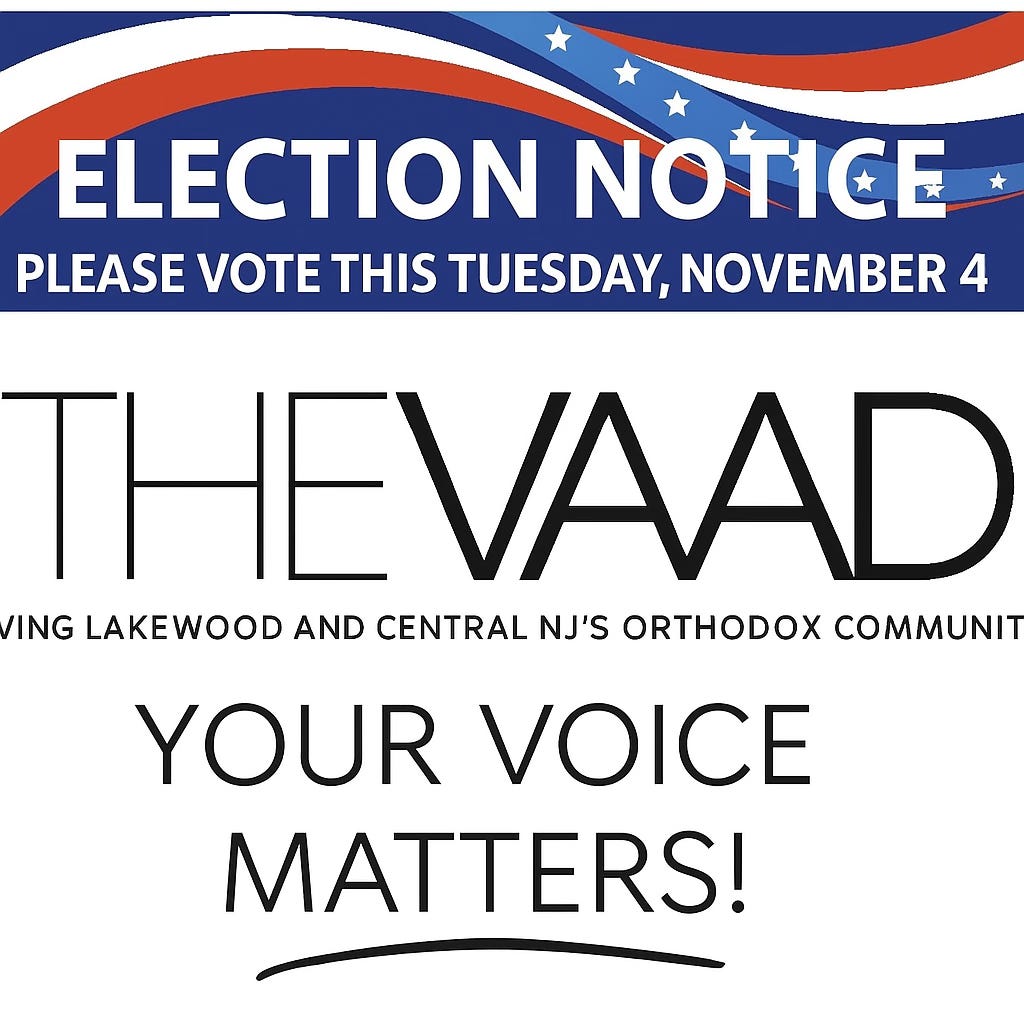
For readers outside the Garden State’s political bloodstream, the Vaad’s endorsement is a big deal. Based in Ocean County, the group represents the interests of the fast-growing Orthodox Jewish community, whose turnout rates are among the highest in the state. When the Vaad speaks, ballots move — not just in Lakewood, but across the expanding ring of towns its members now call home.
In a race within the margin of error, that’s not just an endorsement — that’s an electoral wager with real consequences.
As one of our coveted Zoose readers, journalist and community observer Shlomo Schorr — who closely follows Orthodox political life and is frequently consulted by leaders across Lakewood and beyond — already knows we’re less interested in policy and more focused on turnout, persuasion, and motivation — the mechanics that decide elections.

So we asked him one thing: What kind of real-world impact can this endorsement have?
Here’s our exclusive conversation, edited lightly for clarity and space.
Q: From your perspective, how wide does the Vaad’s influence extend beyond Lakewood? Do you anticipate a ripple effect in other Orthodox or aligned communities (e.g., Passaic, Teaneck, Deal)?
Shlomo Schorr: It extends to the bordering towns where Orthodox Jews have been moving to (including myself) in recent years. Those towns include Howell, Jackson, Toms River, Manchester, and to a lesser extent, Brick.
Q: In practical terms, what kind of turnout bump or voter activation do you expect — thousands of votes, or more subtle shifts in engagement?
Schorr: It can definitely move thousands of votes. You will certainly see a tremendous increase compared to 2021, though not likely to reach 2024.
Q: Given that this endorsement comes eight days before Election Day, how much of the impact do you expect to see in early voting versus Election Day itself?
Schorr: The larger numbers will likely be on Election Day. However, with early voting increasing in popularity, it is expected that we will start seeing an increase there as well.
Q: Does the Vaad endorsement typically move undecided voters, or mainly solidify and mobilize those already leaning Republican?
Schorr: It’s a bit of both.
Q: Compared to 2021, does this year’s endorsement feel more enthusiastic, more strategic, or more cautious in tone?
Schorr: It’s always strategic. Perhaps leaning more cautious this year.
Q: How is the endorsement message being communicated this cycle — and which argument do you believe will resonate most (values, leadership, affordability, education)?
Schorr: Who is better for the community, which includes education, security, affordability, etc.
Q: What’s your gut sense — how meaningful is this endorsement in a three-point race? Could it realistically move the needle?
Schorr: If it is a three-point race and Ciattarelli is looking for large voting blocs around the state — and specifically in Ocean — this can be a large piece of the puzzle for him.
🔍 The Zoose Read
The Vaad endorsement isn’t symbolic — it’s arithmetic. It’s a turnout accelerator, concentrated, coordinated, and timed to peak exactly when the race tightens.
Lakewood and its surrounding towns already punch far above their weight in statewide politics. In 2021, Ciattarelli carried Lakewood by roughly 5,000 votes; this year, Micah noted, that margin could triple or even quadruple.
“In Lakewood proper, Jack can go from a 5,000-vote advantage in 2021 to a 15,000- to 20,000-vote margin in 2025,” Rasmussen told us. “When you include the surrounding communities, it could be another 10,000 on the margin. All in, the endorsement could give Jack about a third of the votes he needs to close his statewide 2021 deficit of 84,000.”
That’s not abstract — it’s a pathway. Ocean County alone could supply roughly 25,000–30,000 net votes toward Ciattarelli’s winning formula.
For Ciattarelli, the Vaad endorsement adds another disciplined, high-turnout bloc to his coalition — one that votes with precision and consistency.
For Sherrill, it’s a reminder that even in a blue state, elections are won by margins, not maps.
📊 How The Zoose Turnout Model Is Stacking Up
Line up every major metric — from early vote to enthusiasm — and the Zoose model continues to hold exactly where we said it would.
Turnout assumptions:
Our 2.7 million turnout estimate remains on pace with VoteHub’s trajectory.
Statewide early returns now total roughly 440 K ballots — 276 K Democratic, 95 K Republican, 68 K unaffiliated — perfectly aligned with last week’s projection and still within 1 % of forecast.
In-person early vote:
All 21 counties have now reported Day 1 totals — 38,060 Democrats vs. 35,533 Republicans, a +2.8 % Democratic edge.
That’s slightly better than 2024’s +1.2 %, but squarely within our predicted +2 to +3 early-vote range.
In other words, Democrats front-loaded their safest votes, while Republicans showed broad, healthy participation — exactly as modeled.
Enthusiasm and composition:
Zoose’s behavioral weighting (digital engagement + low-propensity voter modeling) continues to show an effective D +2 electorate, mirroring both 2024’s early-vote pattern and the emerging 2025 curve.
Momentum indicators:
Republican return rates have tightened to parity (GOP 51.6 % | DEM 52.1 %).
Progressive-left abstention remains visible in live social metrics, while Phoenix engagement (21–44 women) still shows softness — no surge yet in early participation data.
Poll convergence:
Recent polling (Fox, Quinnipiac, FDU, Conway, National Research, Quantus Insights, and Eagleton) clusters between Sherrill +4 to +7, converting to a Zoose-adjusted Sherrill +2.8 once turnout and enthusiasm weighting are applied.
In short:
The new early-vote numbers reaffirm, not revise, our trajectory.
Our model still shows a photo-finish race — balanced within the margin of enthusiasm, not the margin of error.
🧭 The Candidates Path to Victory
At this stage, it’s pure math: who can translate persuasion into participation.
All turnout-based projections assume a 2.7 million voter universe — consistent with Zoose’s blended model of 2021 actuals + current registration and VBM trends.
🐘 Jack Ciattarelli’s Winning Blueprint
Goal: Erase ≈81 k and finish +10 – 40 k.
1️⃣ Lock the base (≥ 92-94 % loyalty, +2–3 % turnout gain) → +10 – 15 k.
2️⃣ Progressive-left abstention (10 % of electorate, 15–20 % sit-out) → +36 – 49 k.
3️⃣ Under-30 men (8–10 % of electorate, +2–3 pt two-way shift) → +11 – 16 k.
4️⃣ Phoenix turnout softness (21–44 women bloc, 5–10 % slip) → +13 – 26 k.
Total swing: ≈ +79 – 103 k → path to a narrow Jack win even if Sherrill keeps her +60 Phoenix margin.
Tone & Ops: Competence over culture; “dad-taxpayer” credibility; pocketbook focus; micro-creator messaging for U30 men; ballot-chase through church, ethnic and late-shift networks; don’t poke the progressive bear — let abstention breathe.
🐴 Mikie Sherrill’s Winning Blueprint
Goal: Protect a +3 and finish +40 – 80 k.
1️⃣ Seal the progressive flank (reduce 20 % abstention → 10 %) → +24 – 25 k.
2️⃣ Phoenix turnout lift (+5–8 % participation) → +16 – 25 k.
3️⃣ Neutralize U30 male drift (limit loss ≤ 10 k) → retain +5–10 k.
4️⃣ Bank early vote + union ops → +15 – 20 k.
Total cushion: ≈ +60 – 80 k → enough to preserve a modest Sherrill edge.
Tone & Ops: Empathy and competence; keep cultural connection high, policy low; union and public-sector ballot-cure war rooms; lean into affordability; ignore GOP men — hold Phoenix and progressives.
⚖️ The TL;DR (too long; didn’t read)
Jack wins with a portfolio of small edges — some progressive-left abstention, modest under-30 male gain, a slight Phoenix turnout dip, and tight GOTV.
Mikie wins by plugging the leaks — progressive retention, high Phoenix energy, limited male drift, and front-loaded ballots.
Both paths are mathematically sound; execution is everything.
What’s keeping the Sherrill campaign up at night?
It’s not Jack’s ads. It’s not Trump’s rallying the loyalists. It’s the measurable quiet revolt simmering inside her own base.
Last Sunday, Newark Mayor Ras Baraka stood beside Sherrill, urging his progressive followers to turn out. But on TikTok, the reaction told a different story — Baraka loyalists flooding the comments with, “Sorry, still voting Baraka,”and “We don’t switch for sellouts.”
So if you think our theory of an “emotional progressive flank” sitting out is overblown — maybe TikTok’s Casey Ward explains it better than any poll ever could.
🧩 The Underdog’s Reality
If this were Vegas — or Polymarket — Ciattarelli would be the value play: priced like a long shot, but drawing more money than the favorite.
He’s still behind in the polls, but ahead in motion — fueled by turnout energy and voter intensity that don’t yet show up in traditional models.
Sherrill remains the steadier hand — methodical, data-driven, backed by institutional heft. But she’s battling the eight-year fatigue cycle that’s doomed her predecessors and an enthusiasm gap inside her own coalition.
This isn’t a wave year; it’s trench warfare. The gamblers may be betting on probability — but the campaigns are fighting over persuasion and turnout.
In the end, the candidate who adds one more motivated voter to their column wins.
🧮 The Zoose Read
We’ve said it since spring: polls measure statements — Zoose measures signals.
The latest signals say this race is tightening beneath the surface, not widening.
Sherrill leads in perception.
Jack leads in participation.
Three points separate them — anyone’s to win or lose — and the next 15 days of persuasion and turnout will decide who’s actually driving the Garden State.
The surface looks steady, but the undertow’s where this race will be won.
Week 39 Rankings
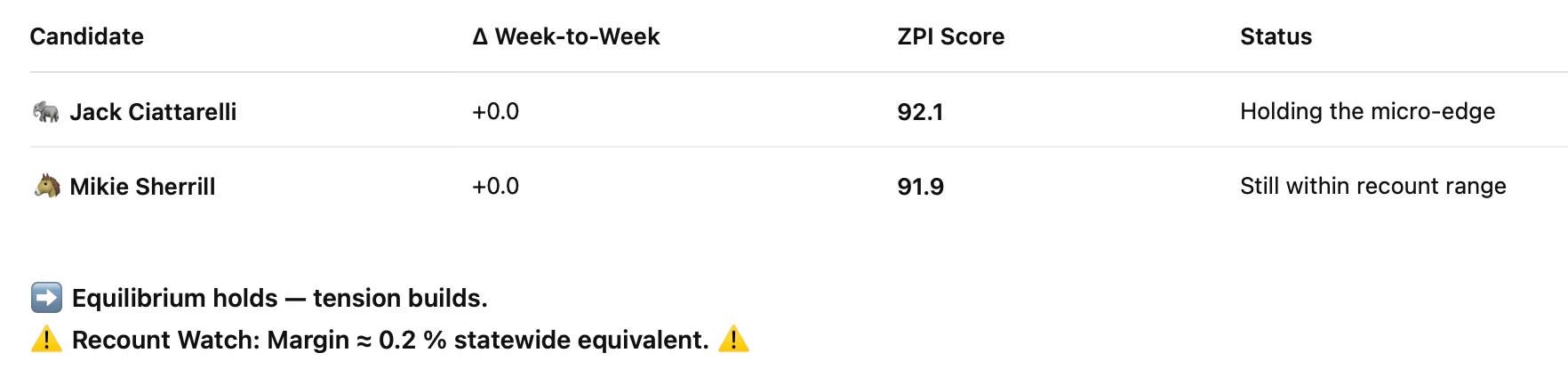
So yes — Sherrill +3 in our early October polling, Ciattarelli +0.2 in the ZPI composite — both can still be true.
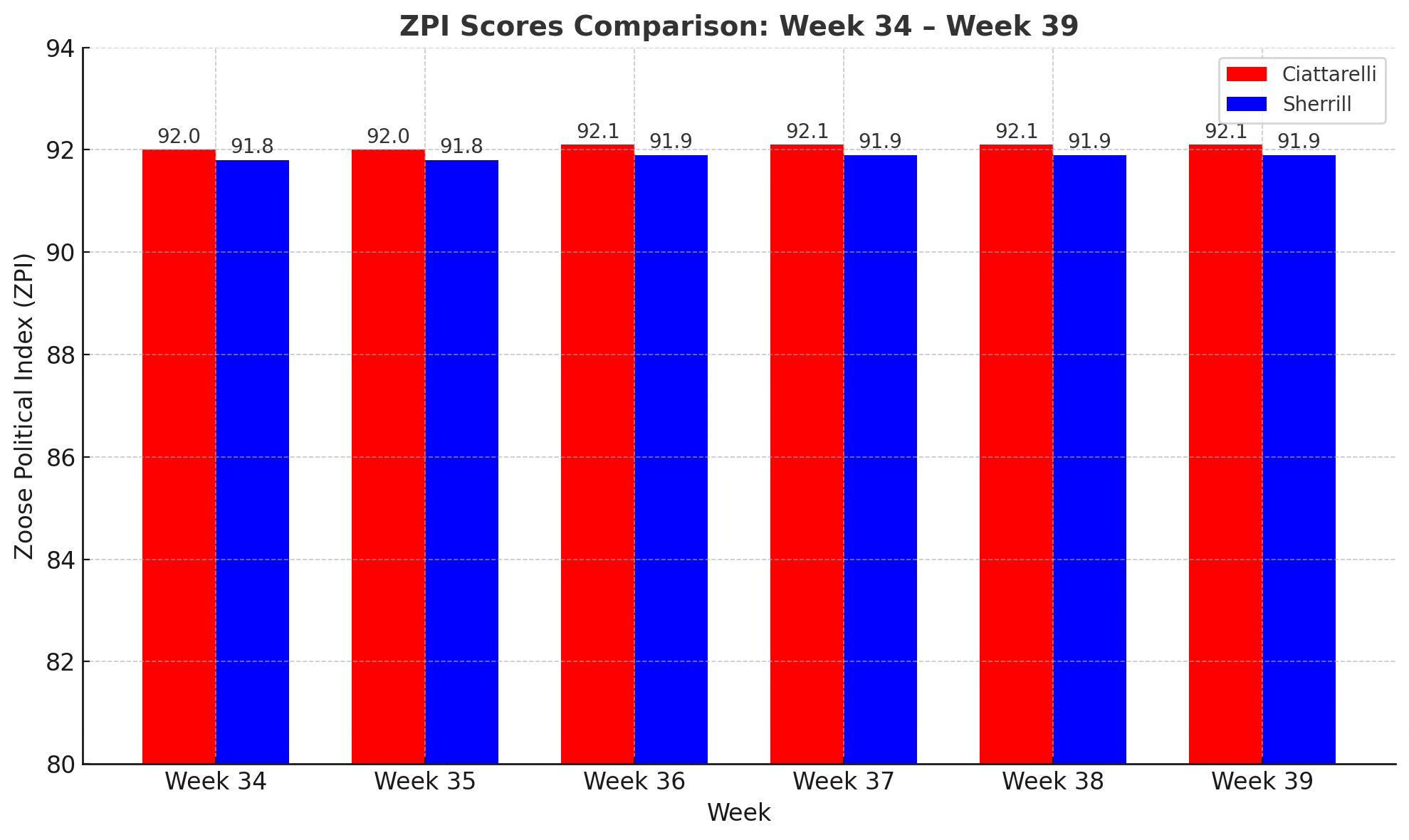
The difference is timing: polls measure sentiment; the ZPI measures execution.
Eight days out, persuasion is baked in. What matters now is performance — who banks ballots, who turns out their late deciders, and who’s still building momentum on the ground.
Democrats’ early-vote lead remains substantial but static — largely drawn from their safest turf. Republicans, meanwhile, are competing in lanes they once conceded and cutting the return-rate gap to near parity.
Saturday’s first day of early in-person voting confirmed it: GOP turnout in Monmouth and Ocean nearly matched Hudson Democrats vote-for-vote. That’s not a poll shift — that’s kinetic movement.
Add the Vaad endorsement, which could deliver a meaningful late boost in Ocean County, and Ciattarelli’s momentum narrative sharpens — even if the math remains tight.
Polymarket still lists Sherrill as the heavy favorite, but the money says otherwise: more dollars are now being wagered on Ciattarelli than on Sherrill. The market knows who the underdog is — it just hasn’t caught up yet.
At this stage, the outcome won’t hinge on persuasion or polls. It comes down to conversion — and every marginal voter counts.
🇺🇸 National Outlook
The headlines were loud:
Trump’s “East Wing demolition” dominated coverage.
“No Kings Day” rallies filled streets across the country, with crowd estimates into the millions.
And yet, the electorate barely blinked.
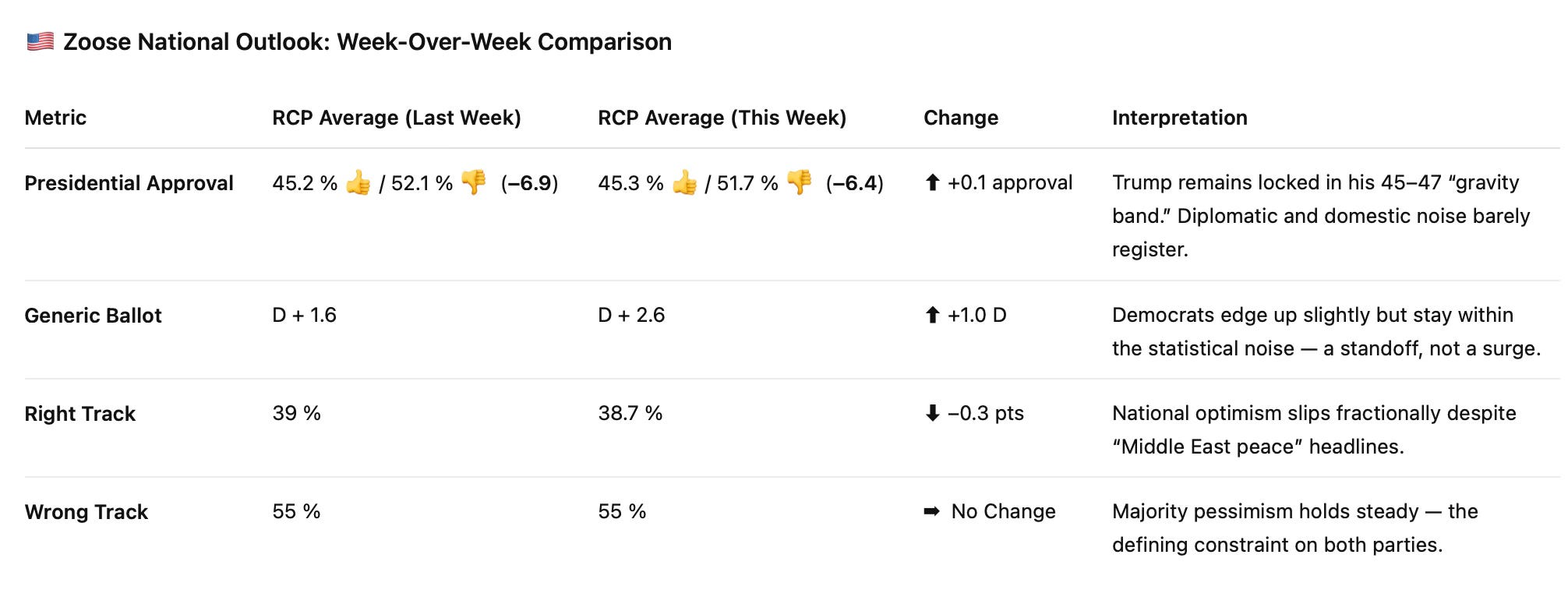
Despite global headlines and viral protests, the national numbers—the four gauges that define the political weather—barely moved. That’s the story.
🏛 Presidential Approval
This week: 45.3 % approve / 51.7 % disapprove (–6.4)
Last week: 45.2 % approve / 52.1 % disapprove (–6.9)
Trump remains suspended in his narrow 45-to-47 corridor — the parameters of his presidency.
Even major diplomatic breakthroughs and domestic unrest couldn’t move the needle. His support floor is firm; his ceiling is glass. Approval has oscillated within a single point for nearly a month, a sign that the electorate’s mind is made up.
⚖️ Generic Ballot
This week: D + 2.6 (45.9 % D / 43.3 % R)
Last week: D + 1.6 (≈ 45 % D / 43 % R)
Democrats ticked up slightly but remain inside the statistical noise. Across pollsters, spreads range from +1 to +9, proof that the center of gravity is holding at a stalemate.
This is not momentum — it’s inertia.
Both parties are spending record sums to defend the same inch of political ground.
📉 Right Track / Wrong Track
This week: Right Direction 38.7 % / Wrong Track 55 % (–16.3)
Last week: Right Direction 39 % / Wrong Track 55 % (–16)
Even after a “historic” Middle East accord and sweeping national protests, the country’s mood remains unmoved.
Optimism hasn’t collapsed — it’s calcified. Americans continue to say things are wrong in roughly the same proportions every week, a reminder that anger is ambient, not episodic.
🧮 The Takeaway
Last week Zoose said the system was in equilibrium. This week all the major polling confirms it.
Presidential approval is static.
The Generic Ballot is balanced.
Right/Wrong Track is unchanged.
The political atmosphere isn’t volatile — it’s viscous. Every headline, every rally, every “turning point” gets absorbed without measurable impact.
For campaigns, that means persuasion is priced in. The only movement left is mechanical: who turns out, who sits out, and who decides the status quo is no longer tolerable.
🔥 8 Minutes a Week with ZPI = More Political Insight Than Most Insiders.
🔹 About Zoose® and Patrick Allocco
Zoose® is an award-winning technology company founded by Patrick Allocco, a veteran campaign operative and former Congressional candidate. Built on multi-patented AI and human-to-human communication tools, Zoose solves real-time challenges across industries—from global support services to political intelligence.
At the forefront of its civic innovation is the Zoose Political Index (ZPI)—a nonpartisan, AI-powered election analysis platform that delivers weekly rankings, turnout modeling, and data-driven insights. ZPI has become a trusted source for understanding the evolving dynamics of the 2025 New Jersey governor’s race and soon beyond.
Patrick Allocco has advised and worked on campaigns at every level—State Senate, Congress, U.S. Senate, gubernatorial, and Presidential—giving him a uniquely practical perspective on voter behavior and strategic messaging. His experience in field operations and coalition-building fuels Zoose’s mission to cut through the noise with clarity, accuracy, and impact.
In 2024, Allocco was recognized in Who’s Who in America for U.S. Technology for his contributions to innovation and AI driven solutions.